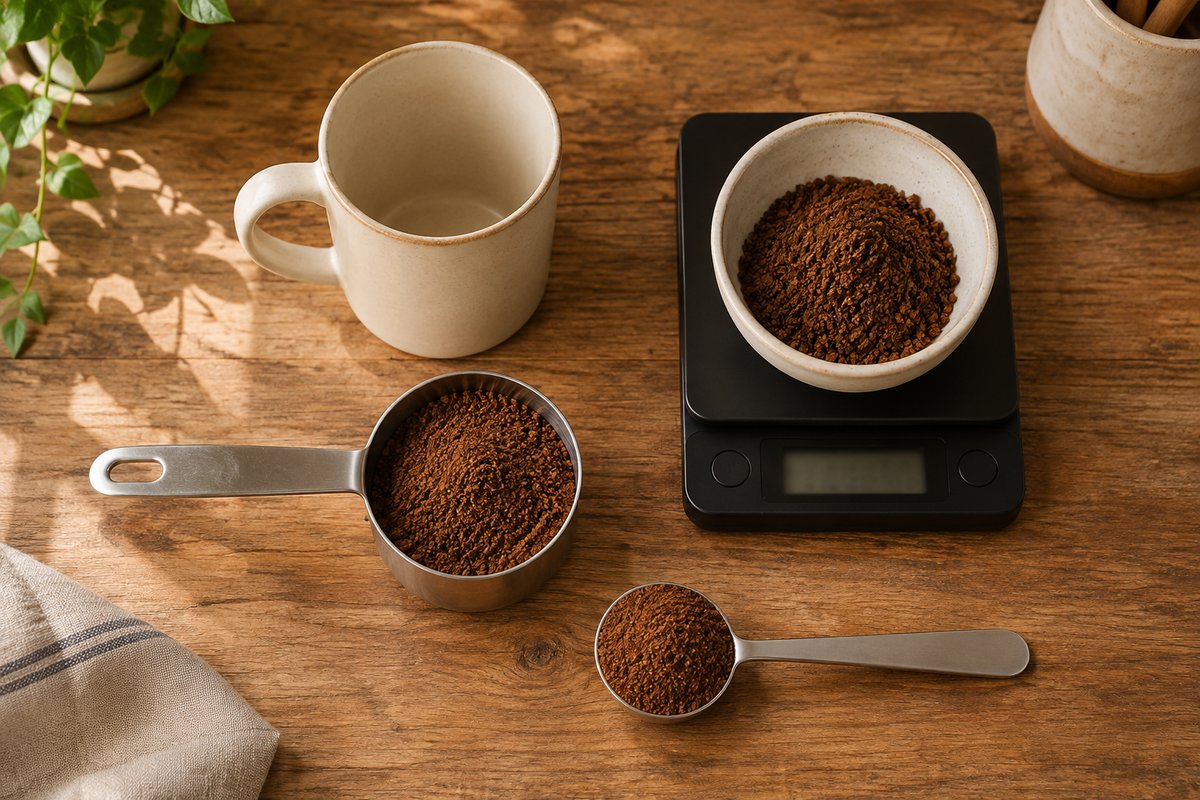
One level tablespoon of ground coffee weighs about 5g. From there, everything else follows:
| Measure | Ground coffee |
|---|---|
| 1 level teaspoon | About 1.7g |
| 1 level tablespoon | About 5g |
| 1 standard coffee scoop (2 tablespoons) | About 10g |
| ¼ measuring cup (4 tablespoons) | About 20g |
| 1 measuring cup (16 tablespoons) | About 80g |
So 15g of coffee is 3 level tablespoons, 9 teaspoons, or 1½ scoops. That is the right amount for one 8-ounce cup.
These are approximations, and the reason matters. A spoon measures space, not weight, and a level tablespoon of ground coffee can weigh anywhere from about 4g to 7g depending on the grind and roast. Every figure on this page carries that same margin. If you want to know how much coffee to use rather than what an amount is, start with how much coffee per cup.
Grams to spoons, scoops, and cups
Find your amount of coffee on the left. The last two columns show how much water it brews at 1:16, the everyday ratio for drip, pourover, and French press, and how many 8-ounce cups that brews.
| Coffee | Tbsp | Scoops | Cups of grounds | Water at 1:16 | Cups brewed |
|---|---|---|---|---|---|
| 5g | 1 | ½ | — | 80ml | ⅓ |
| 10g | 2 | 1 | — | 160ml | ⅔ |
| 15g | 3 | 1½ | — | 240ml | 1 |
| 20g | 4 | 2 | ¼ | 320ml | 1⅓ |
| 25g | 5 | 2½ | ⅓ | 400ml | 1⅔ |
| 30g | 6 | 3 | ⅜ | 480ml | 2 |
| 40g | 8 | 4 | ½ | 640ml | 2⅔ |
| 50g | 10 | 5 | ⅝ | 800ml | 3⅓ |
| 60g | 12 | 6 | ¾ | 960ml | 4 |
| 80g | 16 | 8 | 1 | 1,280ml | 5⅓ |
| 100g | 20 | 10 | 1¼ | 1,600ml | 6¾ |
Tbsp means a level tablespoon. “Cups of grounds” means the dry coffee in a measuring cup. “Cups brewed” means 8-ounce cups of finished coffee. Both get called “cups”, which is why “60g of coffee to cups” has two answers: 60g fills ¾ of a measuring cup, and it brews about 4 cups of coffee.
Water is the easy half. One millilitre of water weighs one gram, so a liquid measuring jug is as accurate as a scale. For other ratios and amounts, the ratio calculator takes grams, tablespoons, or scoops and works out the water.
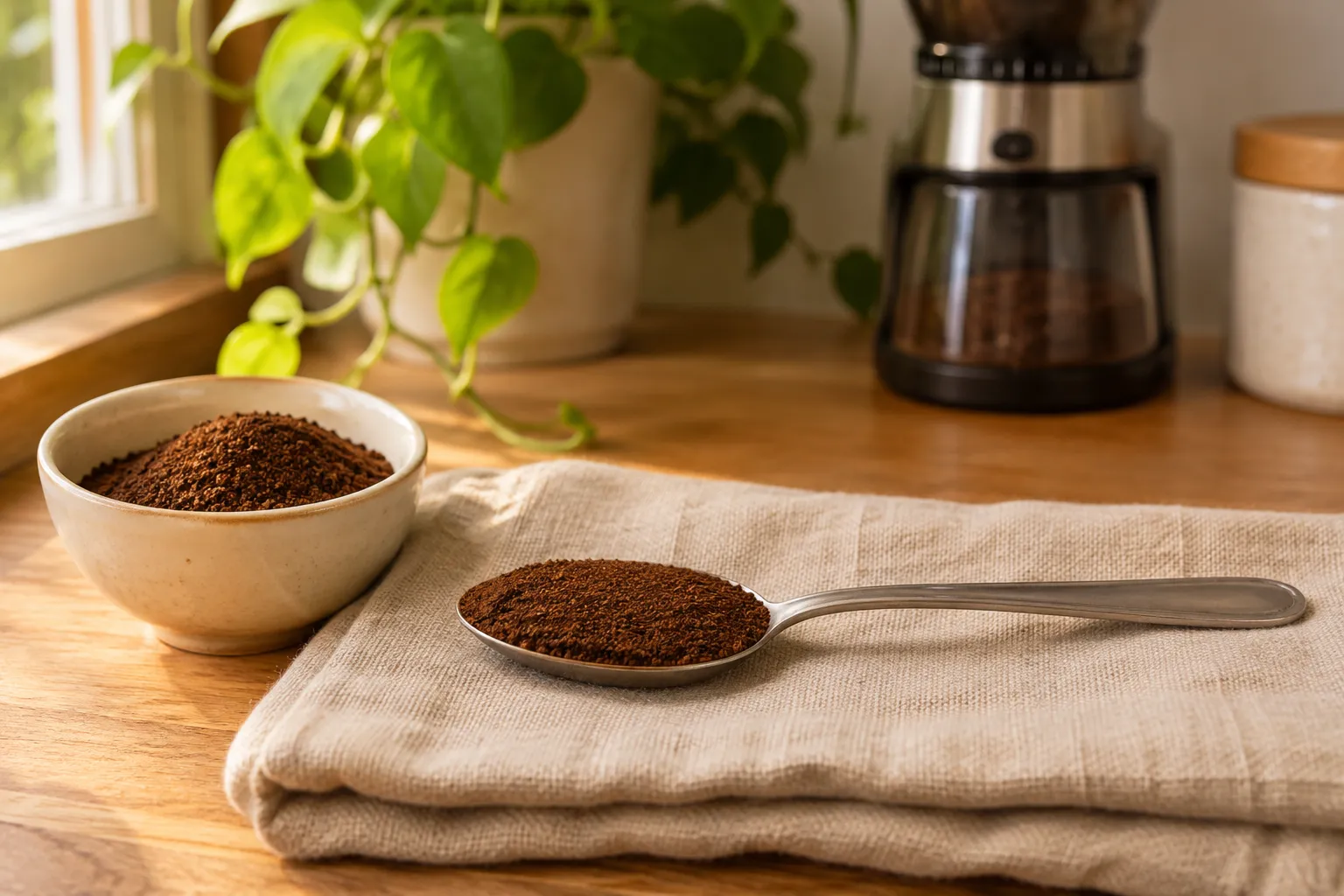
Use a level spoon for the approximate conversions in this guide.
Why a spoon is only close
Three things change what a spoonful of coffee weighs:
- Grind. Fine coffee packs tightly, so a spoonful weighs more. Fine grinds sit toward the top of that 4 to 7g range and coarse French press grinds toward the bottom.
- Roast. Dark roasts lose more mass and puff up in the roaster, so a spoonful of dark roast weighs less than the same spoon of light roast.
- Level or heaped. A heaped spoon holds far more than a level one. Level it with the back of a knife.
Teaspoons need extra care. At about 1.7g, a level teaspoon is too small to measure filter coffee with any accuracy. Turkish coffee is the exception: its powder-fine grind packs so tightly that one heaped teaspoon holds about 7g, which matches the 7g the recipe uses for one cup.
What a coffee scoop holds
A standard coffee scoop holds 2 level tablespoons, or about 10g. Many scoops packed inside coffee tins hold only 1 tablespoon, though, so check yours: count how many level tablespoons of water it takes to fill it.
For one person, that means 1½ level scoops for an 8-ounce cup and a little over 2 scoops for a 12-ounce mug. How much coffee per cup shows how to find what your own scoop weighs using nothing but a new bag of coffee.
Beans or grounds
Weight does not change when you grind, so 15g of beans makes 15g of grounds. Volume does change. Beans and grounds pack differently, so a tablespoon of beans is not a tablespoon of grounds.
If you grind your own, either weigh the beans before grinding or grind first and then measure with a spoon. Measuring beans with a spoon and assuming the ground figures above will put you off by an unpredictable amount.
If you are curious, 15g is roughly 100 roasted beans. Bean size varies too much for counting to be a useful way to measure.
Ounces: weight or volume?
“Ounce” means two different things, and coffee uses both.
- A weight ounce is 28g. Coffee bags are sold by weight: a 12-ounce bag holds 340g.
- A fluid ounce is a volume of about 30ml. Mugs and coffee makers are measured in fluid ounces of water.
For water, the two are almost the same, because a fluid ounce of water weighs about 30g. For ground coffee, they are not. One fluid ounce of grounds is 2 tablespoons, which weighs only about 10g. So “8 ounces of coffee” usually means one of two things:
- 8 ounces of coffee by weight is 227g of beans or grounds, enough for about 15 cups.
- An 8-ounce cup of coffee is 237ml of brewed coffee, made with about 15g of grounds.
How much a bag holds
At 15g per 8-ounce cup:
| Bag | Grams | Cups of grounds | Full 8-oz cups it brews |
|---|---|---|---|
| 8 oz | 227g | About 2¾ | About 15 |
| 250g | 250g (8.8 oz) | About 3 | About 16 |
| 10 oz | 283g | About 3½ | About 18 |
| 12 oz | 340g | About 4¼ | About 22 |
| 1 lb | 454g | About 5¾ | About 30 |
| 2 lb | 907g | About 11 | About 60 |
| 1kg | 1,000g (2.2 lb) | About 12½ | About 66 |
To turn any of these into a price per cup, use the coffee cost calculator.
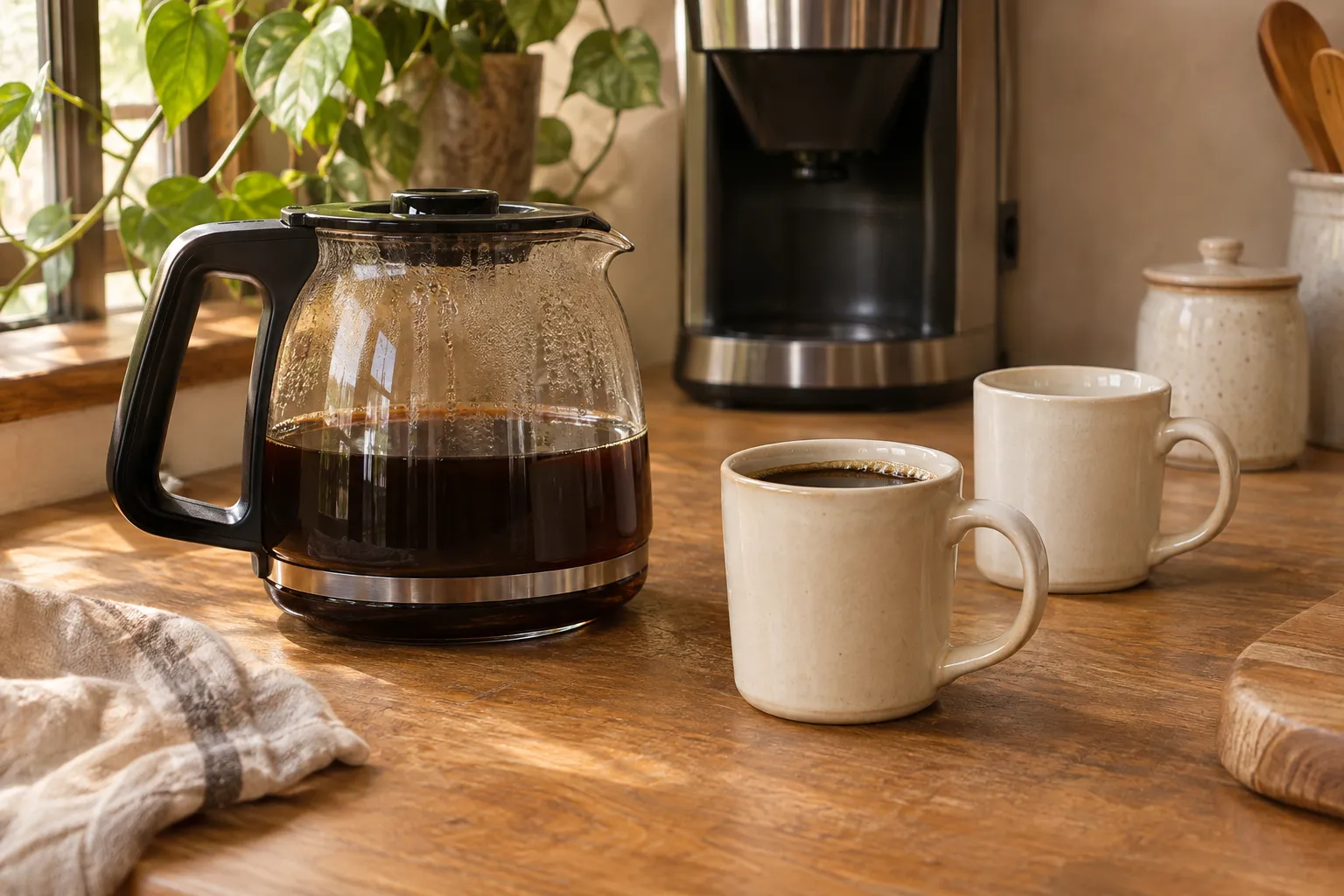
A coffee maker’s small cup marking is different from an everyday mug.
How big is a cup of coffee?
There is no single answer, because “cup” means something different on every container:
| “Cup” | Fluid ounces | Millilitres |
|---|---|---|
| US measuring cup | 8 | 237 |
| Metric cup | 8.5 | 250 |
| Cup on a drip coffee maker | 5–6 | 148–177 |
| Cup on a French press | About 4 | About 118 |
| Typical mug | 12–16 | 355–473 |
| Single espresso | About 1 | About 30 |
The coffee maker figure catches out most people. Its “cup” is a small one, so filling the pot to a line and adding coffee for that many 8-ounce cups makes it far too strong. A cup on your coffee maker is not a cup explains how to measure by the machine’s own lines instead.
How many cups in a pot?
A 12-cup coffee maker holds 60 to 72 fluid ounces, roughly 1.8 to 2.1 litres, depending on the brand’s cup size. That pours:
- 7½ to 9 standard 8-ounce cups
- 5 to 6 typical 12-ounce mugs
A full pot takes about 12 level scoops, or 120g of coffee. For bigger groups, how much coffee for a crowd has amounts by number of people.
When to stop converting and weigh
Spoons are fine for everyday filter coffee, especially once you know what your scoop holds. A scale is worth having when the cup changes from day to day and you cannot tell why, or when you start making espresso, where half a tablespoon either way changes the dose by about 14%. A basic kitchen scale that reads in 1g steps covers everything else on this site.