Baseline recipe
- Coffee
- 18 g
- Water
- 150 g
- Grind
- Fine (table salt)
- Temperature
- Room-temperature water
- Time
- 4–6 minutes
- Ratio
- Fixed by pot size
A Moka Pot is sized by its basket and boiler, so strength comes from the pot you pick. Fill the basket level and dilute in the cup.
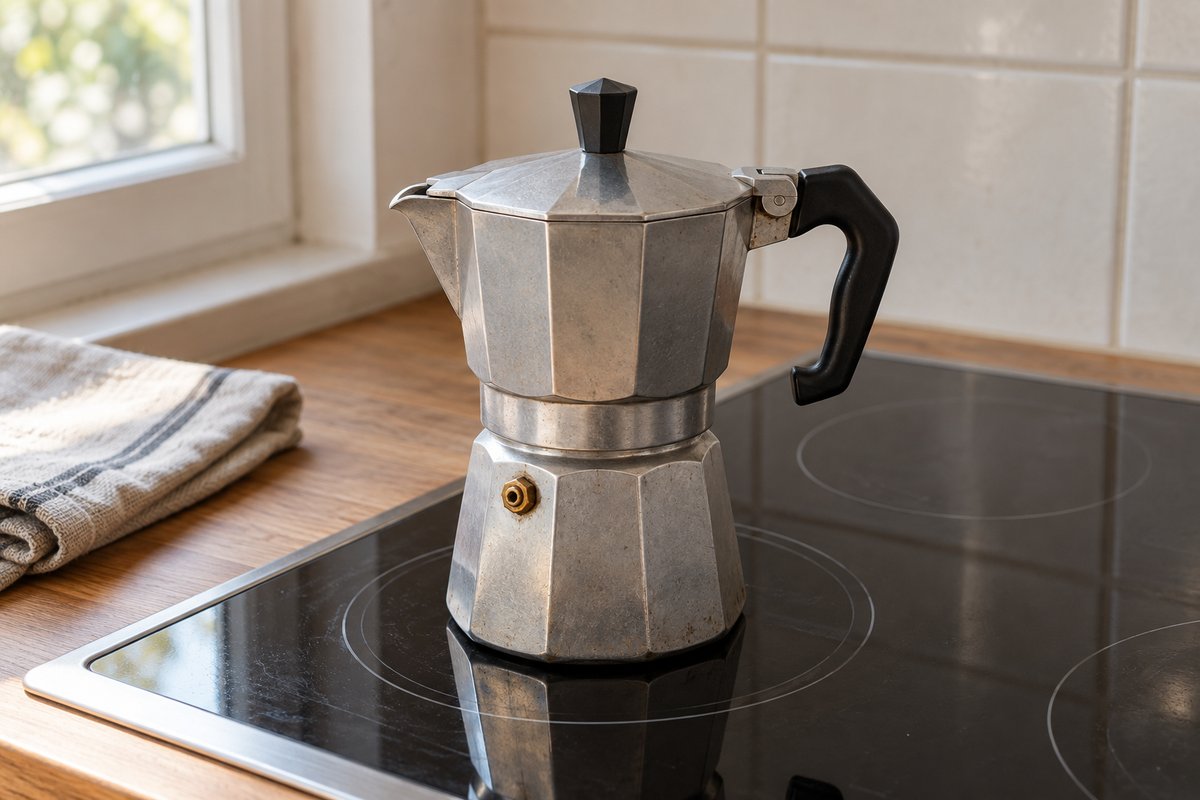
A Moka Pot is three pieces: a boiler for water at the bottom, a funnel-shaped basket for the coffee, and a collecting chamber on top. As the boiler heats, steam builds pressure and pushes the hot water up through the coffee and into the top chamber.
That pressure is only a fraction of what an espresso machine uses, so a Moka Pot does not make espresso. What it makes is short, strong, and heavy-bodied, much more concentrated than drip, and it costs very little. That is why it has been a fixture of Italian kitchens for generations, and why it makes such a good base for milk drinks.
The flip side is that it turns bitter easily. Almost every bad Moka Pot cup comes from too much heat or letting it run too long, and both are easy to fix.
Start with this recipe
For a 3-cup pot: enough for two or three small cups, or the coffee for one latte. For other sizes, see the table below; the steps are the same.
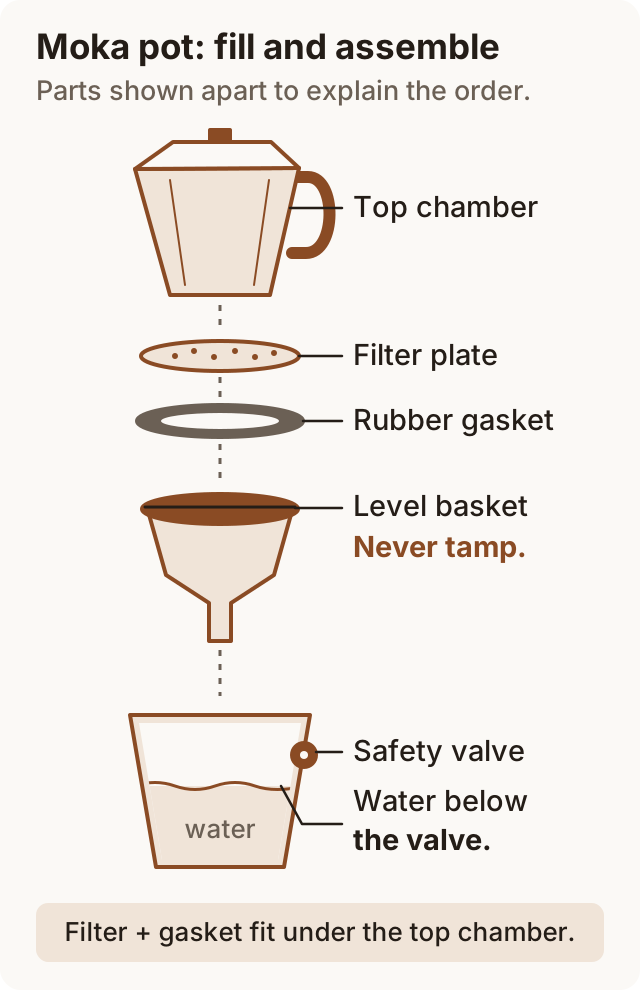
- Unscrew the pot and check that the safety valve on the boiler and the filter plate under the top chamber are clean.
- Fill the boiler with 150g of room-temperature water, to just below the safety valve. Never cover the valve.
- Fill the basket with about 18g of coffee, ground fine. Heap it slightly, then level it off with a finger or knife. Do not press it down.
- Wipe any grounds off the rim, drop the basket in, and screw the top on firmly without overtightening.
- Put the pot on medium-low heat, with the lid closed. On gas, keep the flame under the base, not licking up the sides or the handle.
- When brewing begins, listen for gentle bubbling. If it spits or sputters loudly, lower the heat.
- When you hear the first pronounced gurgle, take the pot off the heat straight away. Run the base under cold water to stop the brew.
- Stir the coffee in the top chamber, then pour.
The whole brew takes about 4–6 minutes. The water-level rule is a safety requirement, not a flavor preference: the valve is there to release pressure if the coffee cannot flow. Keep the lid closed during brewing.
The pot sets the recipe
On other brewers you choose the ratio. On a Moka Pot the boiler and basket choose it for you, so every brew uses a full basket and water to just below the valve. That works out to roughly 1:8 for the 3-cup pot above.
Pots are sold by “cups”, but a Moka Pot cup is a small espresso-sized cup of about 50–60ml, not a mug. Approximate amounts for common sizes:
| Pot | Water | Coffee |
|---|---|---|
| 1-cup | About 60g | About 7g |
| 3-cup | About 150g | About 18g |
| 6-cup | About 300g | About 30g |
Brands and models differ, so treat these as a guide and measure your own pot once: fill the boiler to just below the valve and weigh the water, then weigh a level basket of your usual coffee. Those two numbers are your recipe from then on.
That is also why the ratio calculator leaves the Moka Pot out. If you want more or less coffee, you need a bigger or smaller pot:
- Do not half-fill the basket. The coffee rattles loose, water rushes through, and the cup is weak and uneven. Some pots come with a reducer basket for a smaller batch; use that instead.
- Do not pack in extra. Overfilling or pressing the coffee down slows the flow and pushes the brew toward bitter.
To make it less strong, brew a full pot and add hot water or milk in the cup.
Grind: fine, but not espresso-fine
Grind it fine, like table salt, and a touch coarser than you would for espresso. See the grind scale.
- Too fine, and the water struggles through, the brew slows, and the coffee turns bitter. Fine grounds also slip through the filter into the cup.
- Too coarse, and the water rushes through. The coffee is thin, weak, and sour.
Pre-ground coffee sold for Moka Pots or espresso is usually close enough. Never tamp it the way you would for espresso: a Moka Pot has no pump to push water through a packed bed.
Heat: low and steady
Heat is the Moka Pot’s main control, and the usual mistake is too much of it. A high flame boils the water fast and blasts it through the coffee, which tastes harsh and burnt.
- Medium-low is the right starting point on almost any stove.
- The brew should sound gentle, not spit or sputter loudly. Keep the lid closed; loud sputtering from the start means the heat is too high.
- Stop early. The last part of the brew is the worst part. Once you hear pronounced gurgling, the last of the water is being forced through as a mix of steam and near-boiling water, which pulls out the harshest flavors. Taking the pot off at that point makes the biggest single difference to bitterness.
Aluminum pots, including the classic Bialetti Moka Express, do not work on induction hobs without an adapter plate. Stainless steel pots made for induction do.
About starting with hot water
Some recipes fill the boiler with hot water instead of cold, so the grounds spend less time sitting over the heat before the brew begins. It can soften bitterness, but the base becomes dangerously hot to handle, and Bialetti’s own instructions use room-temperature water. If you try it, hold the boiler with a folded towel and keep it steady while you screw on the top. The room-temperature method above is the safer default.
Fix the cup
| What you notice | Likely cause | First change |
|---|---|---|
| Bitter or burnt | Heat too high, or ran too long | Lower the heat; stop when gurgling begins |
| Weak or thin | Grind too coarse, or basket not full | Grind finer; fill the basket level |
| Slow, or stops flowing | Grind too fine, or coffee packed down | Grind coarser; do not tamp |
| Sputters from the start | Heat too high | Turn the heat down |
| Leaks at the middle | Grounds on the rim, or a worn gasket | Wipe the rim; replace the gasket |
| Grounds in the cup | Grind too fine, or damaged filter plate | Grind coarser; check the plate |
| Metallic or stale | Old coffee oils in the pot | Clean it thoroughly |
The Brew Compass turns any of these into one change for the next pot.
Cleaning and care
Let the pot cool before you take it apart. Knock out the grounds, rinse every part with hot water, and let everything dry fully before you screw it back together. Store it in pieces, or loosely assembled, so trapped moisture does not cause corrosion or smells.
- Aluminum pots are traditionally rinsed with water only, and most are not dishwasher safe: detergent dulls and discolors the metal. Stainless steel pots can take soap.
- The gasket wears out. When the rubber ring under the basket turns stiff, flattened, or cracked, the pot leaks steam and brews weak, sputtering coffee. Replace it rather than screwing the top on harder. A replacement filter plate and gasket cost very little.
- Check the safety valve now and then. It should be clean, with no coffee or scale built up around it.
What to do with it
Drink it short and strong, as it comes. Add hot water for a longer, lighter cup. Or use it the way it works best, with milk: Moka Pot coffee is concentrated and low in acidity, which is why it makes a good latte without an espresso machine.
If you want that intensity without the stovetop, the AeroPress at a low ratio gets close. And if a Moka Pot has you curious about the real thing, see how to brew espresso at home.