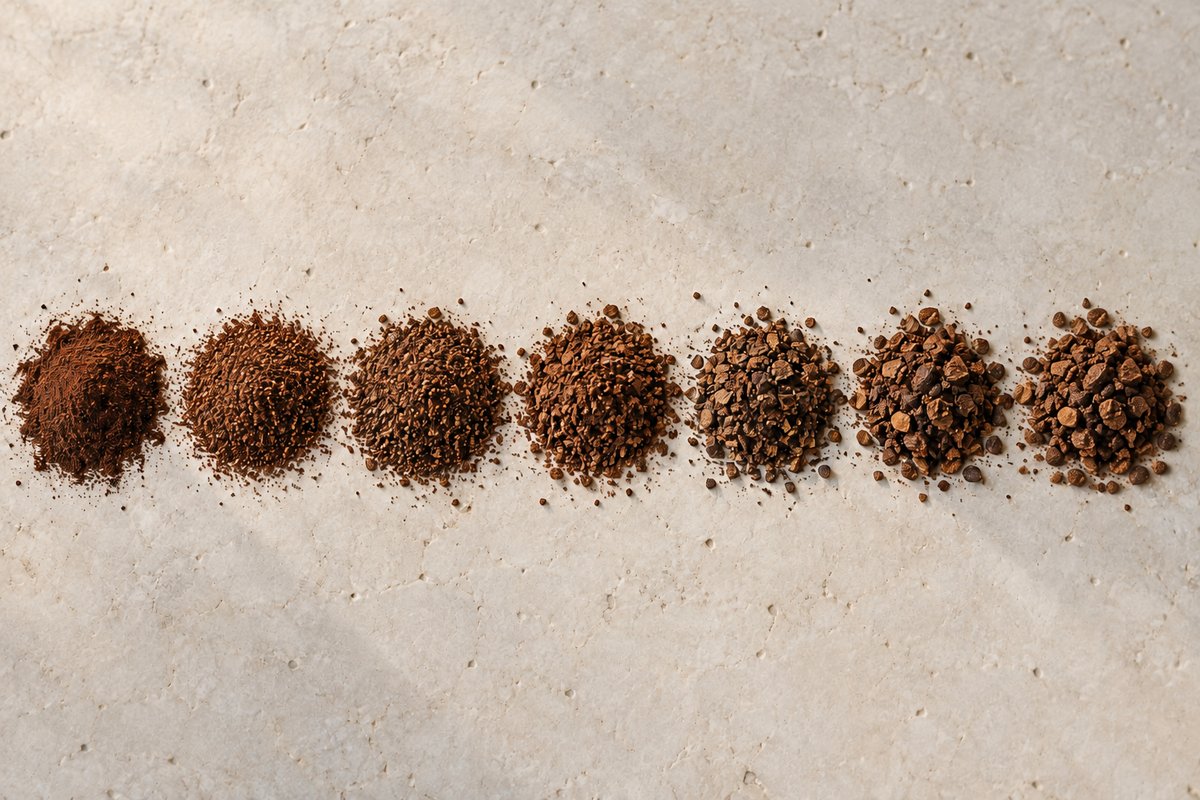
Grind size decides how fast water can pull flavor out of coffee. Change it and everything else changes with it. That is why it is the first thing to adjust when a cup tastes wrong, and the last thing you should change randomly.
What grind size actually controls
Grinding does two things at once:
- It sets the surface area. Smaller particles expose more coffee to water, so flavor dissolves faster.
- It sets the resistance. Smaller particles pack more tightly, so water moves through the bed more slowly.
Those two effects push in the same direction. A finer grind extracts faster and holds the water longer, which is why a small adjustment can swing a cup from sour to bitter. Move in small steps.
The grind scale
Coffee grind is usually described by touch, because grinder numbers mean nothing between brands. Rub a pinch between your fingers and compare it with something in your kitchen.
- Extra fine Powdered sugar · smooth, clings together Turkish
- Fine Table salt · slightly gritty Espresso, moka pot
- Medium-fine Fine sand · grains just visible Pourover, AeroPress, Vietnamese phin
- Medium Beach sand · the usual pre-ground texture Drip
- Medium-coarse Rough sand · clearly separate grains French press, Clever
- Coarse Sea salt · chunky, uneven edges Cold brew, percolator
- Extra coarse Cracked peppercorn · very chunky Long cold steeps
Your grinder’s numbers are yours alone. A “12” on one grinder is not a “12” on another, so record the setting that worked for each brewer rather than trusting the dial’s label.
Where to start for each method
Start here, brew once, then taste before you change anything.
| Method | Starting grind | Feels like | Contact time |
|---|---|---|---|
| Cold brew | Coarse | Sea salt | 12–16 hr |
| French press | Medium-coarse | Rough sand | 4–5 min |
| Drip | Medium | Beach sand | 5–6 min |
| Pourover | Medium-fine | Fine sand | 2:45–3:30 |
| Vietnamese coffee | Medium-fine | Fine sand | 4–5 min |
| AeroPress | Medium-fine | Fine sand | ~2 min |
| Moka pot | Fine | Table salt | 4–6 min |
| Espresso | Fine | Table salt | 25–30 sec |
| Turkish coffee | Extra fine | Powdered sugar | 3–4 min |
Espresso needs a pressure machine and a grinder built for its narrow range, and grind is only half the story there — yield controls strength independently of extraction, which is not true of any other method on this list. See how to dial in espresso for the full model, or diagnose a specific shot with the Espresso Compass.
Read the cup, then move
Two signals tell you which way to go: how long the brew took, and how it tastes.
Taste is the one that decides. Timing is a clue that helps explain the taste.
- Sour, sharp, thin, and it ran fast — the water did not get enough out of the coffee. Grind finer.
- Bitter, drying, hollow, and it ran slow — the water pulled too much. Grind coarser.
- Pleasant but watery — this is not a grind problem. You used too little coffee. Use a lower ratio instead, with the brew ratio calculator.
That last one catches people out constantly. Weak and sour are different problems. Strength is set by your ratio; extraction is set by grind, time, and temperature. Keeping those two jobs separate is most of the skill.
Change one thing at a time
- Move the grinder one or two steps — not five.
- Brew again, keeping dose, water, and temperature identical.
- Taste, and note what you changed.
- Repeat until it tastes good, then write the setting down.
If you change grind, dose, and temperature together, a better cup teaches you nothing, because you cannot tell which change earned it.
Common problems
The brew drains far too slowly. Usually too fine, sometimes too much coffee for the brewer. Coarsen a step. If it is still slow, check for a clogged filter or a bed you have compacted by pouring too hard.
The cup is muddy or silty. Your grinder is producing too many fines — dust-sized particles that slip through filters and keep extracting. Go a step coarser, pour more gently, and use paper rather than metal if you want a cleaner cup. A better burr grinder is the real fix.
Every cup tastes different. Inconsistent particle size, an uneven dose, or rough pouring. Weigh the coffee, level the bed before brewing, and keep your pour steady.
Water channels through one spot. Water has found an easy path and is ignoring the rest of the bed. Level the grounds, wet them evenly at the start, and avoid drilling your pour into one place.
Grinders, briefly
- Blade grinders chop rather than grind, so they make both boulders and dust from the same beans. You can still brew well with one — measure carefully, pulse rather than run it continuously, and shake it between pulses.
- Burr grinders crush beans to a set gap, producing far more even particles. This is the upgrade that improves every method at once, and it matters more than the brewer you own.
Whatever you use, keep it clean. Old grounds retained inside a grinder are stale, and they mix into the next fresh dose. For fines, boulders, and the rest of the grinding vocabulary, see the glossary.
Grind is not working alone
Once your grind is close, these are the other levers, roughly in order of how much they change the cup. Extraction, explained shows how they fit together.
- Ratio — how strong it is. See the calculator.
- Water temperature — hotter extracts faster. Lighter roasts generally want it hotter.
- Contact time — longer extracts more.
- Agitation — stirring, swirling, and pouring hard all speed extraction up.
- Water — mineral content changes what the water can dissolve.
Fresher coffee also needs a slightly different setting than the same bag three weeks later, so expect to nudge the grinder as a bag ages.
Keep those first two jobs separate and everything gets easier: the dose sets how strong the cup is, and the grind sets how it tastes. That split is how the controls in a method’s recipe box are arranged — the strength buttons move the coffee and leave the grinder alone, and the flavor buttons move the grind a single step in one direction.
If the cup still is not right after a couple of grind changes, work through the troubleshooting guide instead of grinding further in one direction.