Baseline recipe
- Coffee
- 20 g
- Water
- 320 g
- Grind
- Medium-fine (fine sand)
- Temperature
- 200°F / 93°C
- Time
- 2:45–3:30
- Ratio
- 1:15 – 1:17
How strong do you like it?
Balanced — 20 g coffee to 320 g water, about 1:16.
Fine-tune the flavor
What do you want to taste?
The recipe as written.
How should it feel?
The recipe as written.
Scale this recipe or diagnose the next cup with the Brew Compass.
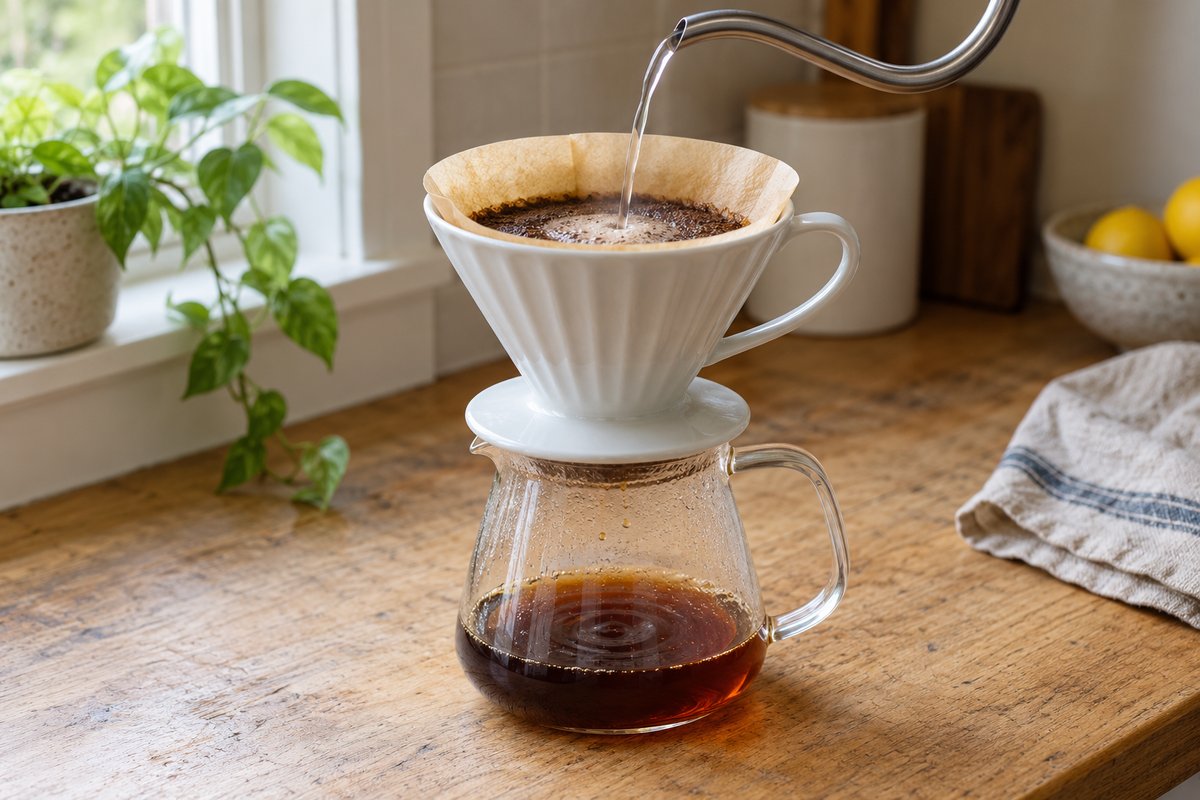
Pourover gives you more control than any other method here, and it asks for more attention in return. You are managing the flow of water through the coffee by hand, so the cup rewards a steady pour and punishes a careless one.
What you get for the effort is clarity. The paper filter removes oils and fine particles, so individual flavors separate out instead of blending together. This is the method for a coffee whose label you actually want to taste. If you are choosing your first brewer, AeroPress vs French press vs pourover weighs that clarity against the effort.
Start with this recipe
Works in any cone brewer. 20g coffee, 320g water, about 3 minutes.
- Rinse the paper filter with hot water. Preheat the brewer and mug, then discard the water.
- Add 20g coffee, ground medium-fine. Shake gently so the bed is level.
- Start a timer. Pour 40g water, wetting every part of the bed, and swirl gently. This is the bloom — let it sit until 0:40.
- At 0:40, pour steadily in circles up to 200g.
- At 1:15, pour up to 320g. Keep the stream slow and centered.
- Give the brewer one gentle swirl to level the bed. It should finish draining between 2:45 and 3:30.
Taste it before you change anything. Then change one variable.
The bloom
The first small pour is not a ritual. Fresh coffee holds carbon dioxide from roasting, and that gas physically pushes water away from the grounds. Wetting the coffee first and waiting 30–45 seconds lets it escape, so the main pours extract evenly instead of around gas pockets.
- Lots of bubbling and rising — fresh coffee, roasted recently.
- Barely any reaction — the coffee is likely a few weeks past roast. Still drinkable; see how to tell if coffee is stale.
Use roughly twice the weight of your dose in bloom water: 20g coffee, 40g water.
Pour technique
This is where pourover is won or lost, and it comes down to one goal: every ground should spend about the same time in contact with water.
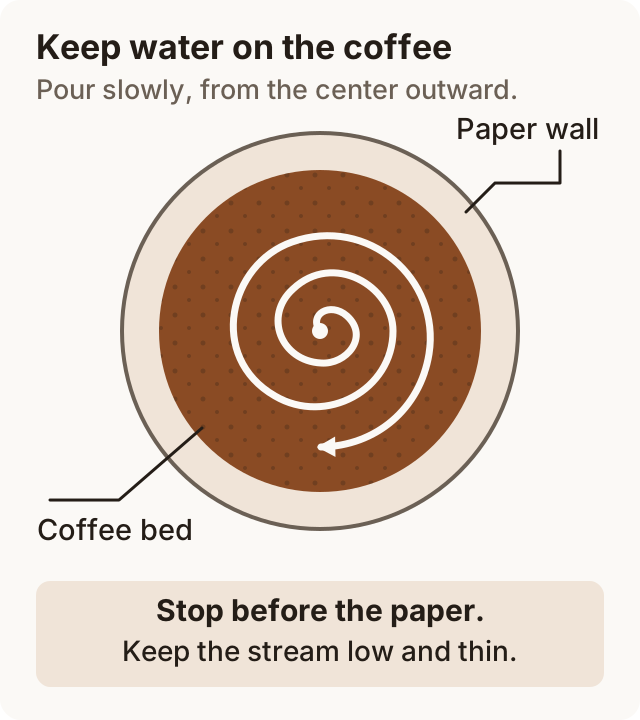
- Pour in slow circles, starting at the center and spiraling outward. Stop before you reach the paper.
- Never pour onto the filter wall. Water that runs down the side bypasses the coffee entirely and dilutes the cup; see bypass water.
- Keep the stream low and thin. A gooseneck kettle makes this easy; a regular kettle poured slowly and close to the bed is workable.
- Keep the water level steady rather than letting the bed run dry between pours.
- Swirl at the end to knock grounds off the wall and flatten the bed.
A flat, even bed of grounds at the end means the water went through evenly. A crater in the middle, or a high ring of grounds up the sides, means it did not.
Channeling is the failure to watch for: water finding one easy path and racing through it, leaving the rest of the bed under-extracted. It tastes simultaneously sour and bitter — some of the coffee over-extracted while the rest barely brewed. Level bed, gentle pour, no drilling into one spot.
Which brewer?
The three common cone brewers behave genuinely differently. None is best; they trade control against forgiveness.
| Hario V60 | Kalita Wave | Chemex | |
|---|---|---|---|
| Shape | Cone, spiral ribs, one large hole | Flat bed, three small holes | Cone, thick glass, one piece |
| Flow | Fast, set by your pour | Slower, restricted by the holes | Slowest, restricted by the filter |
| Cup | Brightest, most aromatic | Balanced, even, sweet | Cleanest, lightest body |
| Forgiveness | Low — technique shows | High — hardest to get wrong | Medium |
| Filters | Cheap, widely available | Wave filters, pricier | Proprietary, thickest, priciest |
| Best for | Chasing clarity in a light roast | A reliable daily cup | Brewing for several people |
Hario V60. The single large opening means you control the flow, not the brewer. That is why it produces the brightest, most detailed cup and why it exposes an uneven pour. Start medium-fine. If it drains much faster than 2:45 and tastes sour, grind finer.
Kalita Wave. The flat bottom and three small holes regulate flow for you, so the bed extracts evenly even if your pour is imperfect. It is the most consistent of the three and the one to buy if you want good coffee rather than a technique hobby. Pour in several small pulses, keeping the water level stable.
Chemex. The filters are substantially thicker than V60 or Kalita papers, which is the whole point — they trap more oils and fines, producing an exceptionally clean, tea-like cup. That thickness also slows the brew, so grind slightly coarser than you would for a V60, especially for larger batches. Rinse the filter thoroughly; unrinsed Chemex papers are the usual source of a papery taste. It is brewer and carafe in one, which makes it the easiest of the three for serving several people.
Scaling up
Hold the ratio and multiply. Above about 40g of coffee, brew time stretches, so grind a step coarser to compensate.
| Makes | Coffee | Water | Notes |
|---|---|---|---|
| 9 oz | 20g | 320g | The baseline recipe |
| 14 oz | 30g | 480g | Add a third pour |
| 21 oz | 45g | 720g | Chemex territory; grind coarser |
You get back less than you pour because the wet grounds hold on to about twice their own weight in water.
Use the brew ratio calculator for anything in between.
Fix the cup
| What you notice | Likely cause | First change |
|---|---|---|
| Sour, thin, drained fast | Under-extracted | Grind finer |
| Bitter, drying, drained slowly | Over-extracted | Grind coarser |
| Both sour and bitter at once | Channeling | Level the bed, pour gently, swirl after the bloom |
| Weak but pleasant | Too little coffee | Use more coffee (1:15, not 1:16) |
| Papery or flat | Filter not rinsed, or stale coffee | Rinse thoroughly; check the roast date |
| Grounds high up the filter wall | Pouring onto the paper | Keep the pour inside the bed |
| Very slow, water pooling | Too fine, or too many fines | Grind coarser |
Treat drawdown time as evidence, not a target. Different coffees produce different amounts of fine particles and drain at different speeds — a coffee that finishes at 3:45 and tastes excellent is not a problem to fix.
The Brew Compass turns any of these into one change for the next cup. If the cup still is not right after two grind changes, work through the troubleshooting guide.
If pourover feels like too much work
That is a legitimate conclusion, not a failure. Drip automates exactly this process and gets most of the way there with none of the attention. The AeroPress gives you a similarly clean cup in about two minutes with far less technique.