Baseline recipe
- Coffee
- 15 g
- Water
- 180 g
- Grind
- Medium-fine (fine sand)
- Temperature
- 195°F / 91°C
- Time
- 2 minutes
- Ratio
- 1:10 – 1:17
How strong do you like it?
Balanced — 15 g coffee to 180 g water, about 1:12.
Fine-tune the flavor
What do you want to taste?
The recipe as written.
How should it feel?
The recipe as written.
Scale this recipe or diagnose the next cup with the Brew Compass.
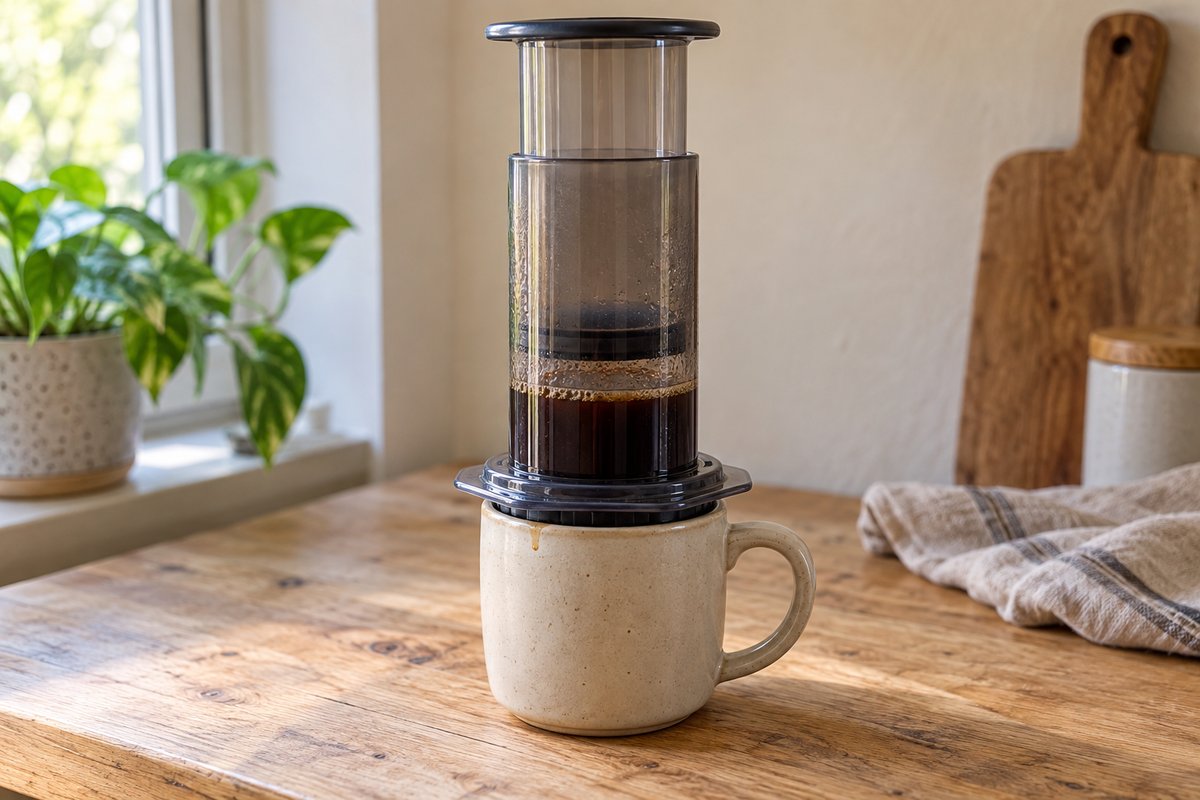
The AeroPress is a plastic tube and plunger. Coffee steeps in the chamber like a French press, then you press it through a paper filter, which gives you a clean cup with almost no sediment. It is quick, hard to break, easy to clean, and forgiving, which is why it is this site’s suggestion for a first brewer if you usually make one cup. Still deciding? AeroPress vs French press vs pourover compares it with the other two common first brewers.
It is also the most flexible brewer here. The same tube makes a light, tea-like cup or a strong concentrate for milk, depending on the recipe.
Start with this recipe
This is a dependable starting point. Change one variable at a time after tasting it.
- Put a paper filter in the cap, rinse it, and attach the cap to the chamber.
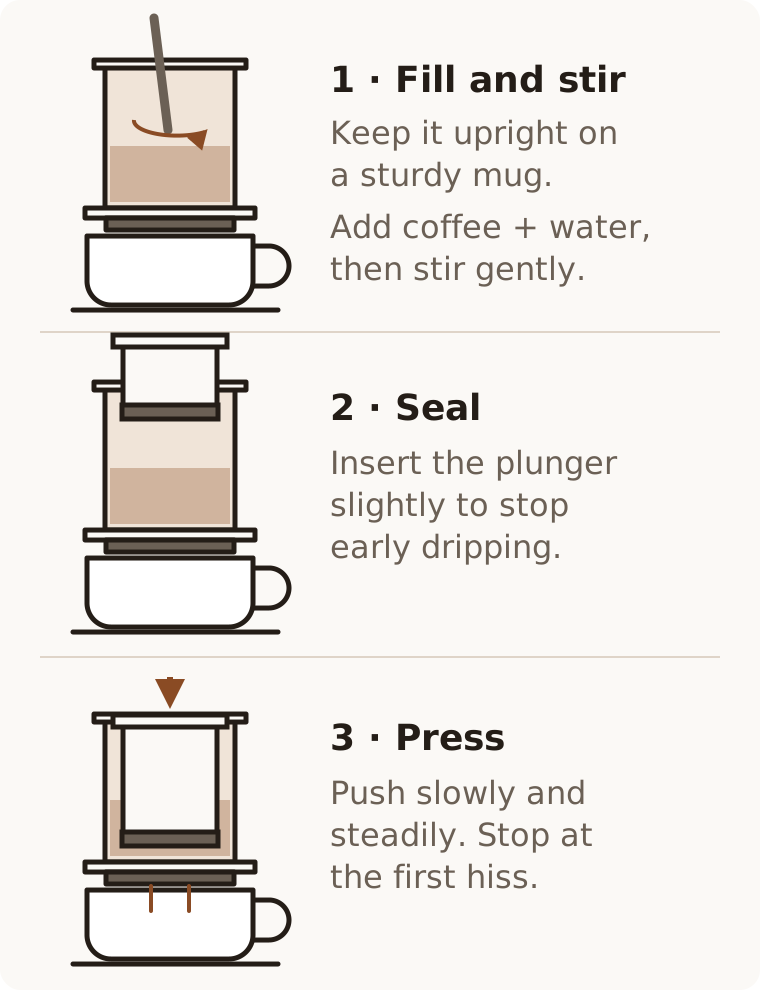
- Set the AeroPress on a sturdy mug. Add 15g coffee, ground medium-fine.
- Start a timer and pour 180g water at 195°F / 91°C.
- Stir gently for 10 seconds, then insert the plunger slightly to stop dripping.
- At 1:15, press slowly. Stop when you hear the first hiss, around 1:45–2:00.
- Swirl the cup and taste it once it cools slightly.
This makes about 150g, or 5 ounces, of coffee, because the grounds hold back some water. For a bigger mug, see making more.
Fix the cup
| What you notice | Likely cause | First change |
|---|---|---|
| Sour, sharp, thin | Under-extracted | Grind finer, or steep 30 seconds longer |
| Bitter or drying | Over-extracted | Grind coarser, or use slightly cooler water |
| Weak but pleasant | Too little coffee | Use a lower ratio, such as 1:10 |
| Too strong | Too much coffee | Add hot water to the cup, or move toward 1:15 |
| Very hard to press | Grind too fine | Grind coarser; press gently and steadily |
| Drips through before pressing | Normal in the standard position | Insert the plunger straight after stirring |
| Silty | Fines through a metal filter | Use a paper filter, or grind a little coarser |
| Papery | Unrinsed paper filter | Rinse the filter before brewing |
Ratio changes strength. Grind and time change extraction. Keeping those jobs separate makes dialing in much easier; see calibrating the grind if the cup will not come right. The Brew Compass turns any of these into one change for the next cup.
Filter choice
The filter sets the texture of the cup rather than its strength.
- One paper filter: the standard. Clean, with very little sediment.
- Two papers stacked: cleaner still, and slightly slower to press. Rinse both.
- A metal disc: lets the oils through for a heavier, rounder body, along with more fine particles. Reusable, so there is nothing to buy again.
None is better than the others. Pick the texture you like.
Temperature by roast
- Light roast: 195–205°F / 91–96°C
- Medium roast: 185–200°F / 85–93°C
- Dark roast: 175–190°F / 79–88°C
These are starting ranges, not rules. If the coffee tastes balanced, the number is working.
Making more
The AeroPress brews one batch at a time, and the chamber sets the limit. The same brew-strong-then-dilute idea works over ice; see iced coffee. The Original makes up to about 10 ounces, the travel-sized Go about 8, and the XL about 20.
For a bigger serving from the Original, brew a stronger batch with less water, then top it up with hot water in the cup. This keeps the overall ratio at 1:12, the same as the baseline:
| Coffee | Water | Top up | Makes |
|---|---|---|---|
| 12g | 144g | — | 4 oz |
| 15g | 180g | — | 5 oz |
| 20g | 200g | 40g | 7 oz |
| 30g | 150g | 210g | 10 oz |
The last row is enough for two small cups. Because less water does the brewing, a concentrate extracts a little less; if it tastes thin, grind slightly finer or steep 30 seconds longer. Bypass water explains why, and how much top-up suits other brewers.
With an AeroPress XL, you can simply double the baseline: 30g of coffee and 360g of water. For amounts in between, use the ratio calculator, and keep the water within what your chamber holds.
The inverted method
The inverted method prevents early dripping and allows a longer steep, but it also requires flipping a brewer full of hot water.
Hot-water warning: Keep the plunger inserted by at least ½ inch / 1.25cm, work on a clear counter, and hold both parts firmly while flipping. Use the standard method if grip, balance, or heat is a concern.
- Insert the plunger securely and stand the brewer upside down.
- Add 15g coffee and 180g water.
- Stir, steep for 60–90 seconds, and attach the rinsed filter cap.
- Hold the chamber and plunger together, flip onto a sturdy mug, and press slowly.
The James Hoffmann recipe
Probably the most widely used AeroPress recipe there is, and a good second recipe to try once the baseline above is working. It is gentler than most: no inverting, no stirring, and a longer steep. At roughly 1:18 it is also lighter than the baseline recipe above, so expect a more tea-like cup rather than a bold one.
- Set the AeroPress in the standard position on a sturdy mug. Do not rinse the filter or preheat the brewer.
- Add 11g coffee, ground medium-fine.
- Pour 200g water, aiming to wet all the grounds as you go.
- Insert the plunger about 1cm into the chamber straight away. The vacuum stops the coffee dripping through.
- Steep for 2 minutes.
- Holding the chamber and plunger together, swirl gently — do not stir — then let it settle for 30 seconds.
- Press gently all the way down.
Use around 90–95°C for a medium roast and 85–90°C for a dark roast. The swirl instead of a stir is deliberate: it redistributes the grounds without driving extra extraction, which keeps the cup sweet rather than sharp.
Verified championship recipes
Competition recipes are intentionally unusual. They are useful for experimentation, not as everyday defaults.
Carolina Ibarra Garay, 2018 world champion
- 34.9g coffee, coarse grind
- 100g brewing water at 185°F / 85°C
- Inverted brewer and rinsed paper filter
- Pour for 30 seconds, then stir vigorously for 30 seconds
- Flip and press for 30 seconds
- Dilute with 60g hot water and 40g room-temperature water
Wendelien van Bunnik, 2019 world champion
- 30g coffee, coarse grind
- 100g brewing water at 198°F / 92°C
- Inverted brewer and rinsed filter
- Pour in 10 seconds and stir 20 times
- Flip at 40 seconds and press, producing roughly 60g concentrate
- Add about 120g water, adjusting dilution to taste
Sources: 2018 winning recipe and 2019 winning recipe.
Cleaning
Eject the coffee puck, rinse the cap and seal, and let the parts dry separately. A quick rinse after each brew prevents old coffee oils from affecting the next cup.
The rubber seal hardens and shrinks over years of use. If the plunger starts sliding down on its own or the press feels loose, replace the seal rather than the brewer.
Want the same clean cup with more control over how flavors separate? Try pourover next.