Baseline recipe
- Coffee
- 18 g
- Yield out
- 36 g
- Grind
- Fine (table salt)
- Temperature
- 198–200°F / 92–93°C
- Time
- 25–30 sec
- Ratio
- 1:1.5 – 1:3
Espresso changes strength by how much liquid you pull, not by how much coffee goes in.
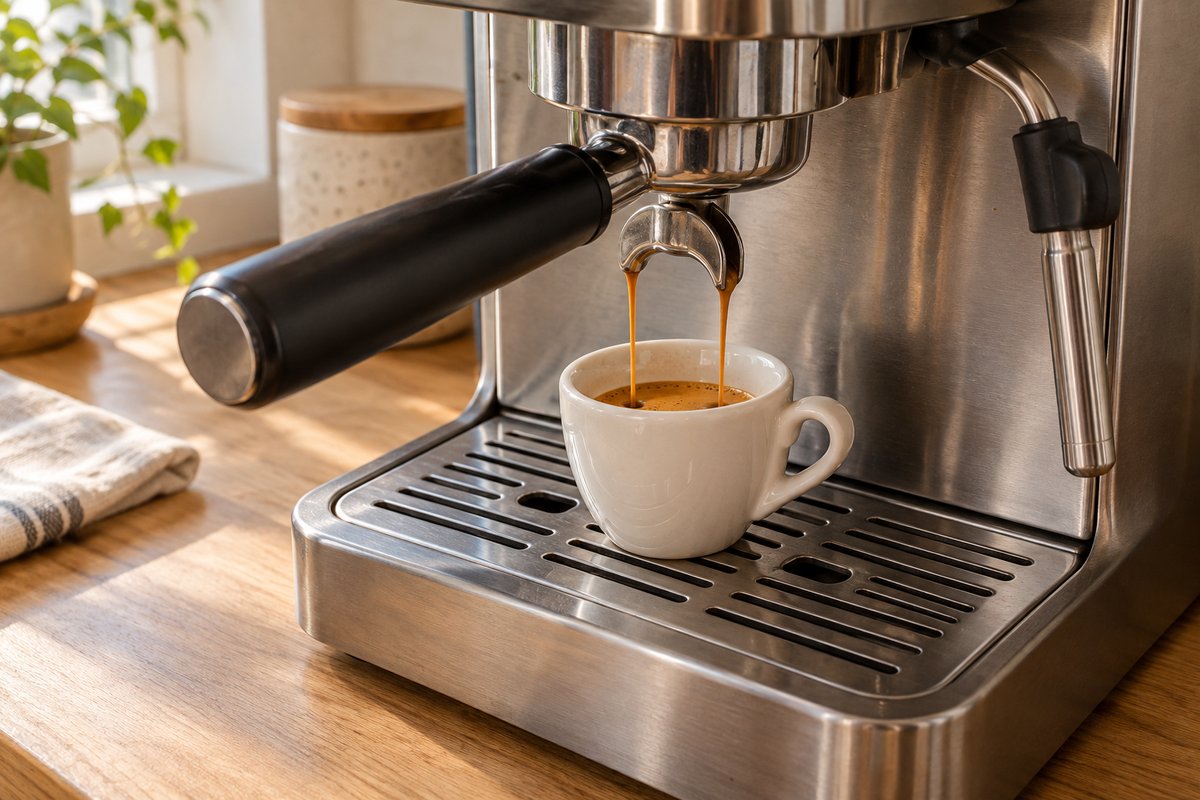
This is the demanding one
Every other method on this site forgives a rough measurement. Espresso does not: it forces water through packed, fine grounds under real pressure, and small mistakes in dose, grind, or puck prep show up immediately as a sour, bitter, or gushing shot. It also needs a dedicated pressure machine and a grinder built for the range espresso lives in — a pour-over grinder set as fine as it goes still will not get you there.
If that sounds like more than you want, Moka Pot gets close to espresso’s strength and body from a stovetop for a fraction of the cost, with far more room for error. If you already have the machine, this page is a baseline recipe. The full mechanics — why grind is the first lever, how to read a shot’s timing, and what changes with a pressurized basket — live in How to Dial In Espresso.
What you need
- An espresso machine. Any machine with a standard, single-wall basket can make the recipe below. A machine that only has a pressurized basket works too, with limits; see pressurized baskets and pods.
- A grinder that can grind for espresso. This matters as much as the machine. Many burr grinders built for filter coffee cannot grind fine enough, or cannot make small enough adjustments at the fine end.
- A scale that reads to 0.1g and fits under the portafilter with a cup on it. Espresso is measured by the weight in the cup, not by eye.
- A tamper that fits your basket. Most machines come with one.
New to the vocabulary? Dose, yield, puck, and crema are all in the glossary.
Start with this recipe
This is the specialty-coffee standard baseline. Almost every home machine and grinder can reach it.
- Dose 18g of fresh coffee, ground fine — like table salt — into your portafilter basket.
- Break up every clump with a thin tool, level the bed, and wipe the rim clean.
- Tamp level and firm. Force matters less than an even, level surface.
- Lock in and start the shot immediately. Water should reach 198–200°F / 92–93°C.
- Stop at 36g in the cup — a 1:2 ratio.
- Note the time. 25–30 seconds from the first drop is the target window.
Taste it. The clock is a diagnostic reading, not something to chase — see time is a reading for why.
If it doesn’t taste right
| What you taste | Likely cause | First change |
|---|---|---|
| Sour, sharp, thin | Under-extracted | Grind finer |
| Bitter, hollow, drying | Over-extracted | Grind coarser |
| Sour and bitter together | Channeling — water found a shortcut | Fix the puck, not the recipe |
| Sprayed, spurted, or went pale fast | Channeling | Fix the puck, not the recipe |
| Balanced but thin or overpowering | Ratio is off, not extraction | Pull it longer or shorter |
| Gushes out fast and pale | Grind far too coarse | Grind several steps finer |
| Drips slowly or barely flows | Grind far too fine | Grind several steps coarser |
| Little or no crema | Stale coffee, or a pressurized basket | Check the roast date first |
Sour-and-bitter in the same sip is the one combination that is never a recipe problem. Fix the puck — declump, level, tamp flat — before touching the grind. The Espresso Compass will walk through this with you and turn your numbers into the exact next shot.
Scaling the dose
The basket sets your dose, not taste — use the size stamped on it or the one your portafilter came with.
| Basket | Dose | Typical yield (1:2) |
|---|---|---|
| Single | 8–10g | 16–20g |
| Double | 14–18g | 28–36g |
| Triple / VST | 20–22g | 40–44g |
Ristretto (1:1–1:1.5) is heavier and sweeter, built for milk; see how to make a latte for the milk side. Lungo (1:3+) is lighter and more transparent, and asks more of the grind before it turns hollow. Espresso ratios has the yield for every dose and how to pull each style.
Puck prep, briefly
More of what makes a home shot fail traces back to the seven seconds before you lock in the portafilter than to the grind setting. Break up every clump — a thin needle-style tool works better than a finger — distribute the grounds level, and tamp flat rather than hard. A rim of loose grounds left on the basket edge is a leak water will find. The full channeling section covers what to do when a shot still sprays or blondes early after clean prep.
Pressurized baskets and pods
Many entry-level machines ship a pressurized (dual-wall) basket, which builds its own back-pressure regardless of grind. It is forgiving and produces thick crema, but the crema is partly aeration rather than a sign of a well-pulled shot, and grinding finer or coarser barely moves the result. If that is what you have, dialing in on a pressurized basket explains what actually works and why a single-wall basket is the cheapest upgrade available. Pod and capsule machines fix the grind and dose before you touch anything — see dialing in with pods.
Cleaning
Backflush with water after each session if your machine has a solenoid valve, and with detergent weekly. Wipe the group head and basket after every shot — old coffee oils turn rancid and taint the next one. Descale on the schedule your machine’s manual gives, sooner in hard-water areas.
Want the full method behind this recipe — grind calibration by shot time, what to do about channeling, and setup-specific advice? Read How to Dial In Espresso, or diagnose a specific shot right now with the Espresso Compass.