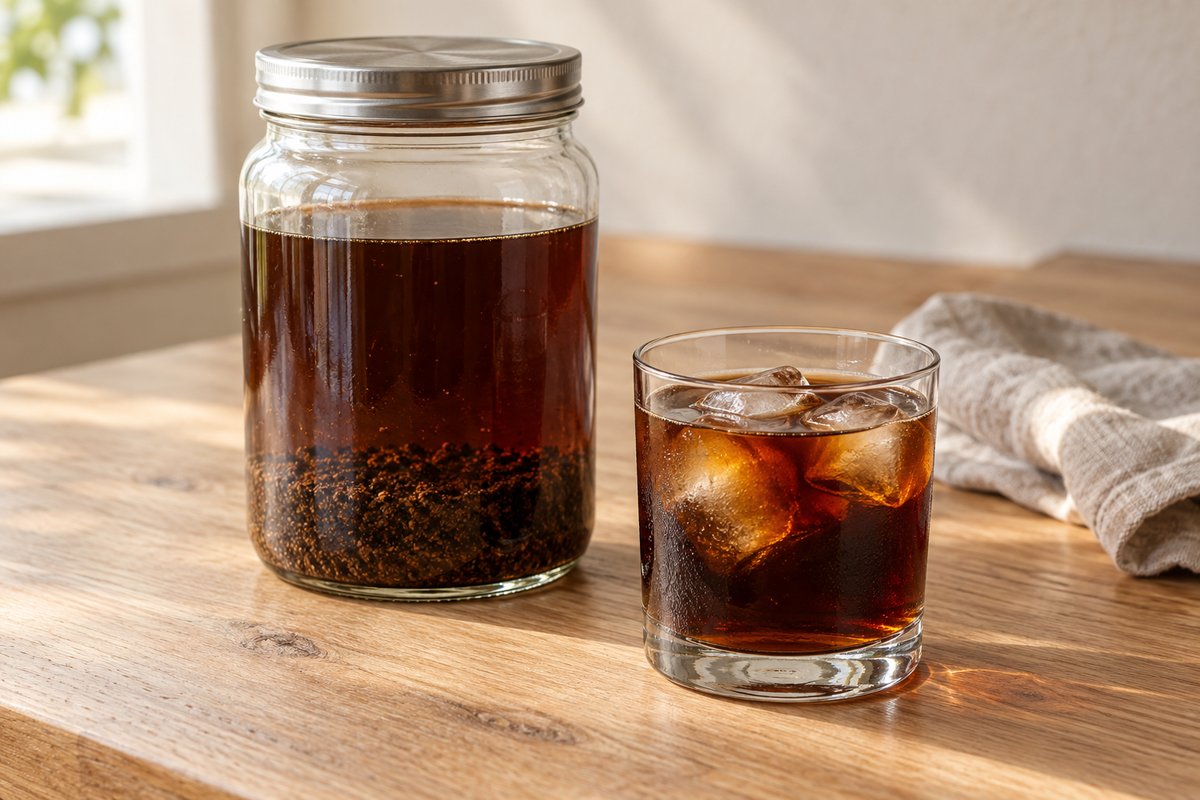
For cold brew you drink straight, use 1:10: 100g of coarse coffee per litre of water. For a concentrate, use 1:6 and dilute it 1:1 with water or milk. Both end up at about the same strength in the glass. The concentrate just takes up half the fridge space and lets you choose the strength when you pour.
Those two numbers are enough to make good cold brew. The rest of this guide explains why cold brew needs so much more coffee than hot coffee, why a concentrate is not automatically the stronger drink, and how much coffee fits in the jar you already own. For the brewing itself (grind, steep time, and straining), see how to make cold brew.
Why cold brew needs more coffee
Hot coffee at this site’s usual 1:16 uses about 63g of coffee per litre. Cold brew uses 100g or more for the same amount of water. That is not a typo, and it is not waste.
Cold water dissolves flavour much more slowly than hot water. Even after 12 to 16 hours, it pulls less out of each gram of coffee than a four-minute hot brew does. So to get a cup with the same body and flavour, you start with more coffee. The lower acidity people love about cold brew comes from the same slow, cold extraction.
The ratio is still coffee to water by weight: 1:10 means 1g of coffee for every 10g of water. One millilitre of water weighs one gram, so a measuring jug works for the water.
Concentrate or ready to drink
This table starts from 600g of water, the batch on the cold brew method page, and shows what each ratio gives you. “Comes out” allows for the grounds holding on to about twice their own weight in water. The last column is the useful one: how much coffee went into a 12-ounce glass of the finished drink, before ice.
| Ratio | Coffee | Comes out | Dilute | Finished drink | Coffee per 12-oz glass |
|---|---|---|---|---|---|
| 1:5 | 120g | 360g | 1:2 | 1080g | 39g |
| 1:6 | 100g | 400g | 1:1 | 800g | 44g |
| 1:8 | 75g | 450g | 1:1 | 900g | 30g |
| 1:10 | 60g | 480g | None | 480g | 44g |
| 1:12 | 50g | 500g | None | 500g | 36g |
For comparison, a 12-ounce mug of hot drip coffee at 1:16 uses about 25g.
Three things stand out:
- 1:6 diluted 1:1 matches 1:10 straight. Same strength in the glass, from a jar half the size. That is why it is the concentrate this guide recommends.
- A weaker concentrate, diluted the same way, makes a weaker drink. 1:8 diluted 1:1 lands lighter than ready-to-drink cold brew. If yours tastes thin, you can dilute less rather than brew again.
- Very strong concentrates need more water. At 1:5, a 1:1 dilution is about a third stronger than ready-to-drink cold brew. Start at 1:2 and work back.
All of this is before ice. Ice adds water as it melts, often 50 to 100g in a full glass, so cold brew served over ice tastes lighter by the bottom of the glass than the table suggests.
How to dilute a concentrate
Dilution is just the second half of the ratio, done in the glass instead of the jar.
- Pour the concentrate first: say 120g, about half a cup.
- Add the same amount of cold water or milk for a 1:1 dilution.
- Taste it before adding ice. If it is too strong, add water a splash at a time. If it is weak, use less water next time, or brew the next batch at a lower ratio.
Milk counts as dilution. Half concentrate and half milk is the same strength as half concentrate and half water, just richer. If you want an iced latte style drink, a 1:1 concentrate-to-milk pour is a good place to start.
You can always weaken cold brew, but you cannot strengthen it. If you are unsure, brew stronger. A concentrate that is too strong takes a splash of water. A batch that is too weak is weak for the week.
How much coffee for your jar
Leave room in the jar for the grounds and for stirring: the coffee takes up space, and a full jar is hard to mix without dry pockets. These amounts are for a 1:6 concentrate.
| Jar | Coffee | Water | Concentrate | Diluted 1:1 |
|---|---|---|---|---|
| Pint (16 oz / 473ml) | 50g | 300g | About 200g | About 400g, 14 oz |
| Quart (32 oz / 946ml) | 100g | 600g | About 400g | About 800g, 27 oz |
| Half gallon (64 oz / 1.9L) | 200g | 1200g | About 800g | About 1.6kg, 54 oz |
No scale? Coarse coffee runs a little lighter than the 5g tablespoon that how much coffee per cup uses, so these are close:
- 50g is about 10 level tablespoons, or a generous ½ cup.
- 100g is about 20 tablespoons, or 1¼ cups.
- 200g is about 40 tablespoons, or 2½ cups.
For a ready-to-drink batch at 1:10 instead, use the same water and cut the coffee to 30g, 60g, or 120g. You will get more to drink straight from the jar, but storing the same number of glasses takes twice the fridge space.
Use the calculator for other sizes
The ratio calculator opens on cold brew at 1:10. Type in the water your jar holds and it gives you the coffee. For a concentrate, change the ratio to 6.
The yield it shows is what comes out of the jar after the grounds soak up their share. For a concentrate, that is before you dilute, so double it to see how much you will drink.
Ratio is not the only dial
Ratio sets strength. Steep time and grind set extraction, which is the difference between a sweet cup and a woody or sour one. If the strength is right but the flavour is off:
- Harsh, woody, or drying: steep shorter or grind coarser.
- Sour or thin despite plenty of coffee: steep longer, or grind a step finer.
- Silty or heavy: strain it again through paper.
The cold brew method page has the full fix table, and which coffee has the most caffeine explains why a strong concentrate poured straight carries far more caffeine than a mug of drip.
Cold brew or iced coffee?
If you want cold coffee today rather than tomorrow, or you like the bright, fruity taste that cold brewing smooths away, brew hot coffee straight onto ice instead. See how to make iced coffee.