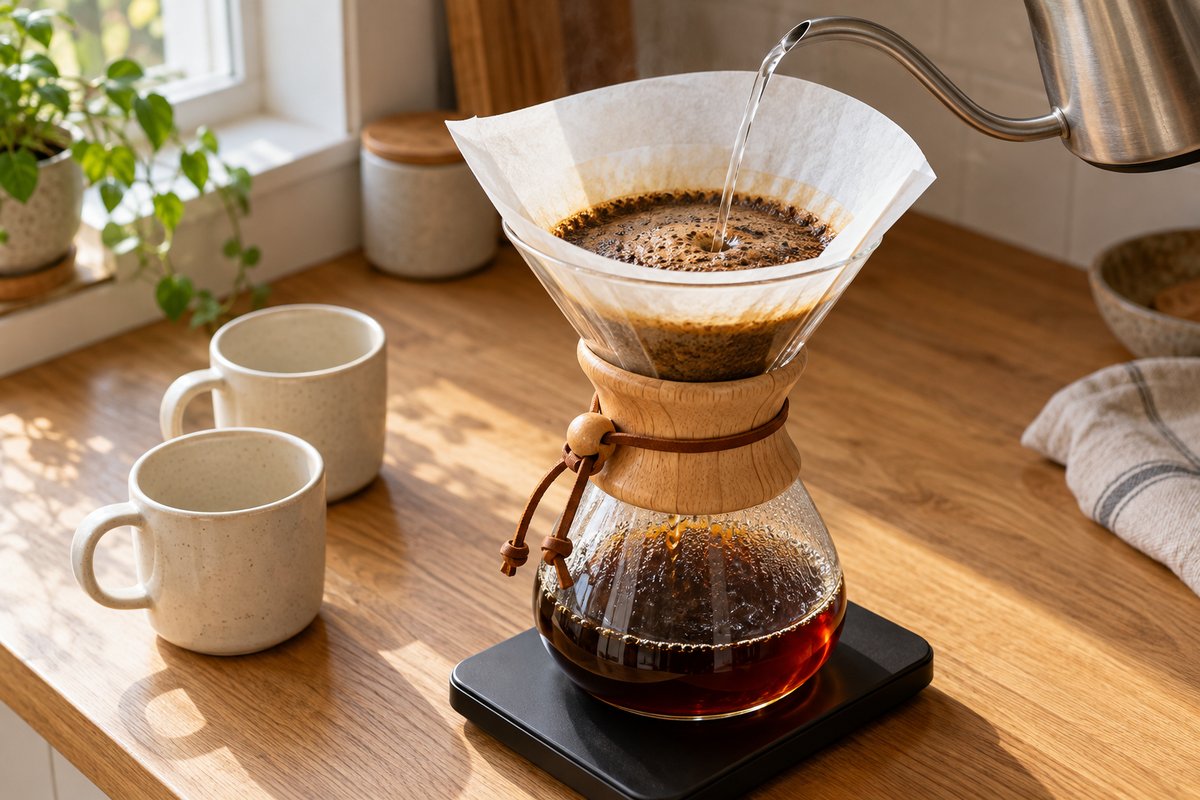
For two mugs from a six-cup Chemex: 40g of coffee ground medium-coarse, 640g of water at about 94°C (201°F), an 80g bloom, then two pours, finishing between 4:00 and 5:00. That is a 1:16 ratio, the same as the site’s pourover recipe, with a coarser grind and a longer brew to suit the Chemex’s thick filter.
The Chemex is a pourover cone and a serving carafe in one piece of glass. The chemist Peter Schlumbohm designed it in 1941, and it has barely changed since. What sets it apart is the paper. Chemex filters are much thicker than V60 or Kalita papers, so they hold back more of the coffee’s oils and fine particles, and they slow the water down. The result is a cup that is light-bodied, very clear, and sweet, and a brewer that makes enough for the whole table.
Start with this recipe
For the six-cup Chemex, the most common size. You need a scale, a kettle, and a timer.
- Fold the filter in. Open the folded paper so that one side has three layers and the other has one. Set it in the cone with the three-layer side over the spout. The thick side keeps the paper from collapsing into the spout, which leaves a channel for air to escape as the coffee drips.
- Rinse the filter with plenty of hot water. That washes out papery flavors and warms the glass. Pour the rinse water out through the spout, holding the filter in place, or lift the filter out for a moment and set it back.
- Add 40g of coffee, ground medium-coarse, like rough sand. Give the Chemex a gentle shake so the bed is level.
- Bloom. Start a timer and pour 80g of water, enough to wet every ground. Stir gently with a spoon or swirl the Chemex so no dry pockets remain. Wait until 0:45 while the coffee bubbles and settles.
- First pour. At 0:45, pour in slow circles up to 360g. Aim to get there by about 1:30.
- Second pour. At about 2:00, once the level has dropped by a third, pour up to 640g, reaching it by about 2:45.
- Let it drain. It should finish between 4:00 and 5:00. Lift out the filter when the drips slow to a few seconds apart, and drop it, grounds and all, into the compost.
- Swirl the carafe before you pour. The first coffee through is the strongest, and it sits at the bottom until you mix it in.
You get about 560g of coffee, roughly 19 ounces: two generous mugs, or three or four small cups. The wet grounds hold on to about twice their weight in water, which is why you get back less than you pour.
Water at about 94°C (201°F), 20 seconds or so off the boil, suits a medium roast. Use it straight off the boil for a light roast, and about 90°C (194°F) for a dark one. While the coffee drains, run hot water into the cups you will serve in. A warm cup keeps the last sips as good as the first.
Why the Chemex brews differently
Three things about its design explain how it behaves.
- The thick paper sets the pace. A V60 lets your pour decide how fast water flows. In a Chemex, the paper does most of the deciding, so the brew runs slower and is less sensitive to an uneven pour. That is why the grind is coarser than for a V60: a fine grind behind a thick filter drains too slowly and turns bitter.
- The paper holds back the oils. Less oil and sediment means a lighter body and flavors that stay distinct. It also means less cafestol, the compound in coffee oil that raises cholesterol; see filtered vs unfiltered coffee.
- The carafe is part of the brewer. There is no separate server, which makes it easy to brew for several people. The glass “button” on the side marks the halfway point on the five- to ten-cup sizes, and the full line on the three-cup.
| Chemex | V60 | |
|---|---|---|
| Filter | Thick bonded paper | Thin paper |
| Flow | Slow, set mostly by the paper | Fast, set by your pour |
| Grind | Medium-coarse | Medium-fine |
| Cup | Very clean, lighter body | Bright and aromatic |
| Usual batch | Two to four mugs | One or two mugs |
If you mostly brew a single mug, the V60 recipe is the better fit. Pourover compares both with the Kalita Wave.
The pour
A Chemex is more forgiving than a V60, but a few habits still keep every ground brewing for about the same time.
- Pour slowly and keep the stream low, a few centimeters above the coffee. A gooseneck kettle helps, but an ordinary kettle poured carefully works too.
- Pour in small circles over the middle of the bed and stay off the paper. Water poured down the side of the filter runs around the coffee instead of through it.
- Keep the water well below the rim of the cone. A Chemex cone holds plenty, but filling it to the top pushes water down the sides of the paper.
- Watch the bloom. Fresh coffee rises and bubbles for the first half minute. If it barely moves, the coffee is probably stale; see how to tell if coffee is stale.
Dial it in by brew time
The total brew time is your clearest clue to the grind, because the paper and the dose stay the same from day to day.
| Finishes | Tastes | Change |
|---|---|---|
| Before about 3:45 | Sour, thin, a little hollow | Grind finer |
| 4:00 to 5:00 | Clean and sweet | Keep the grind |
| After about 5:30 | Bitter, drying, flat | Grind coarser |
| Stops partway | Filter sealed at the spout | See “If it stalls” |
Treat the time as evidence, not a rule. A cup that finishes at 5:15 and tastes good is a good cup. Change one thing per brew, usually the grind by one step, and note the time and one word about the taste. Calibrating the grind explains how far one step should move things.
If it stalls
A Chemex that suddenly stops draining is usually not a grind problem. Air needs a way out of the carafe as coffee drips in. If the paper collapses into the spout, or the single-layer side ends up over the spout, the filter seals against the glass and the flow slows to a crawl.
Lift the filter edge at the spout for a second to let the air out, and check the fold next time. If it is draining slowly everywhere, with no seal at the spout, the grind is too fine.
Brewing more or less
Hold the ratio and multiply. A bigger bed drains more slowly, so grind a step coarser above about 45g of coffee. A small bed drains faster, so grind a step finer below about 30g.
| Chemex | Coffee | Water | Bloom | Makes | Notes |
|---|---|---|---|---|---|
| 3-cup | 25g | 400g | 50g | About 12 oz | Grind a step finer |
| 6-cup | 30g | 480g | 60g | About 14 oz | One large mug |
| 6-cup | 40g | 640g | 80g | About 19 oz | The baseline recipe |
| 6- or 8-cup | 50g | 800g | 100g | About 24 oz | Grind a step coarser; add a third pour |
| 8- or 10-cup | 60g | 960g | 120g | About 28 oz | Grind a step coarser; add a third pour |
Split the water into the bloom plus two or three roughly equal pours, starting each one when the level has dropped by about a third. A Chemex “cup” is 5 ounces, so the six-cup holds 30 ounces when full. The brew ratio calculator works out any amount in between.
One mug in a big Chemex? It works, but 20g of coffee makes a shallow bed in a large cone, so it drains quickly. Grind a step finer. If one mug is your usual brew, the three-cup Chemex or a V60 suits it better.
Fix the cup
| What you notice | Likely cause | First change |
|---|---|---|
| Sour and thin, finished early | Under-extracted | Grind finer |
| Bitter and drying, finished late | Over-extracted | Grind coarser |
| Flow stops partway through | Filter sealed over the spout | Three-layer side over the spout; lift the edge to let air out |
| Papery or cardboard taste | Filter not rinsed well enough | Rinse with more hot water, especially natural papers |
| Weak but pleasant | Too little coffee | Use 1:15 instead of 1:16 |
| Flat, little aroma, barely bloomed | Stale coffee | Check the roast date |
| Thin and lukewarm by the second cup | Cold glass and cups | Rinse the filter with more hot water; warm the cups |
For problems that are not specific to the Chemex, see fix sour, bitter, or weak coffee, or use the Brew Compass to choose one change for your next brew.
Choosing a Chemex and filters
Size. The three-cup suits one large mug. The six-cup is the most common and handles one to three mugs. The eight- and ten-cup sizes are for brewing for a group. Buy for the amount you usually make, because a small batch in a big cone drains too fast.
Style. The classic Chemex has a wooden collar tied with a leather cord, which you hold when the glass is hot. The glass-handle version brews the same way and is simpler to wash.
Filters. Use Chemex bonded filters for the size you own. The six-cup takes squares, half-moons, or circles; the three-cup needs a smaller paper, so check the box. White papers taste the most neutral. Natural, unbleached papers need a longer rinse. Stay with one kind while you dial in, because different papers drain at different speeds.
Reusable metal filters fit a Chemex too. They let oils and fine particles through, so the cup is heavier and less clean, closer to a French press. That trades away the clarity most people buy a Chemex for, and lets more cafestol into the cup.
Iced coffee in a Chemex
The carafe makes a good iced-coffee brewer, because the hot coffee drips straight onto ice and chills at once. Put 210g of ice in the carafe, brew 40g of coffee with 430g of hot water, and grind a step finer to make up for the smaller amount of hot water. Swirl until the ice is nearly melted, then pour over fresh ice. How to make iced coffee explains the method.
Looking after it
Wash the Chemex with warm, soapy water and a long bottle brush, and rinse it well. On the classic model, untie the leather cord and slide off the wooden collar before the glass goes in the dishwasher. Coffee oils build up as a brown film in the carafe over time. A soak in hot water with a little dishwasher detergent or a coffee-equipment cleaner lifts it, and stops it from adding a stale taste to the next pot.