Baseline recipe
- Coffee
- 30 g
- Water
- 480 g
- Grind
- Medium-coarse (rough sand)
- Temperature
- 200°F / 93°C
- Time
- 4 min steep, 9 min total
- Ratio
- 1:14 – 1:17
How strong do you like it?
Balanced — 30 g coffee to 480 g water, about 1:16.
Fine-tune the flavor
What do you want to taste?
The recipe as written.
How should it feel?
The recipe as written.
Scale this recipe or diagnose the next cup with the Brew Compass.
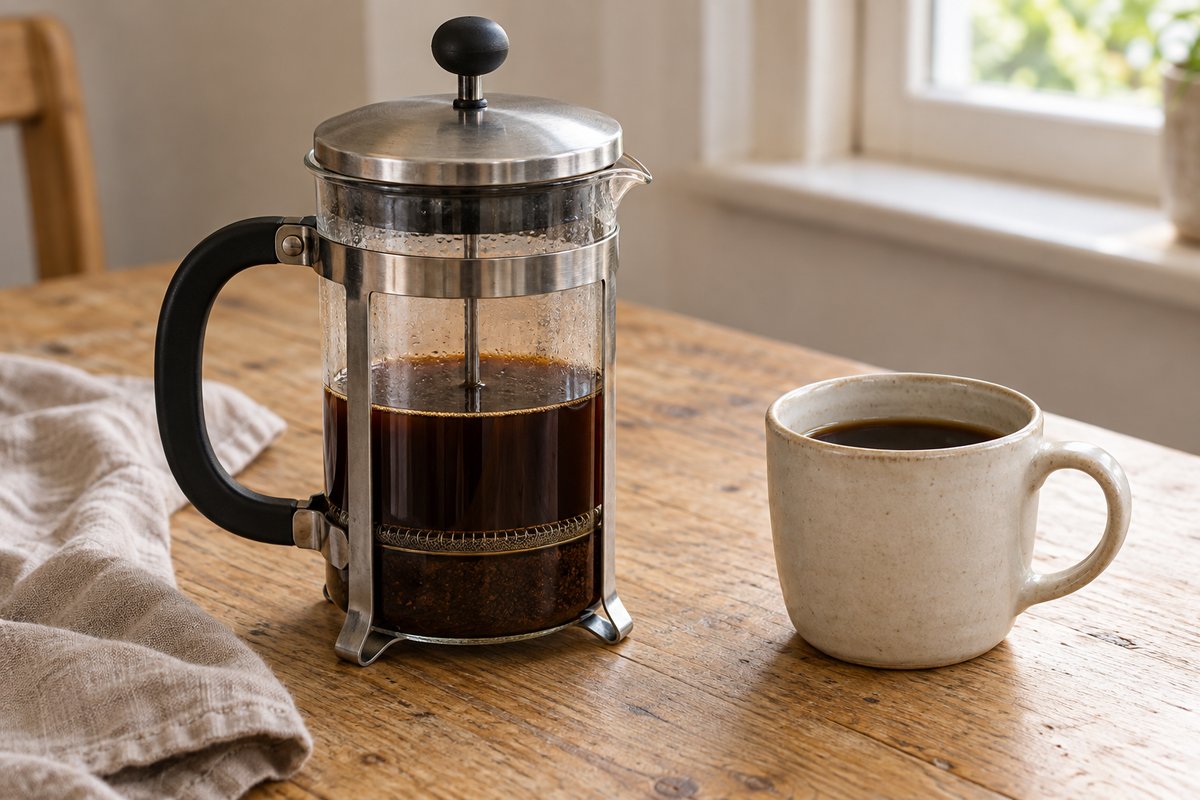
The French press asks less of you than any hot method here. There is no pouring technique to learn and no paper filter to buy — coffee sits in water, then you separate them. The metal mesh lets oils and fine particles through, which is what gives the cup its weight and texture. AeroPress vs French press vs pourover shows how that trades off against the two other common first brewers.
It also has one well-known flaw: sediment. Most of this page is about avoiding it. And if you drink several cups a day, know that the same oils carry cafestol, a compound that raises cholesterol; see filtered vs unfiltered coffee.
Start with this recipe
- Preheat the press with hot water, then tip it out.
- Add 30g coffee, ground medium-coarse.
- Start a timer and pour 480g water at 200°F / 93°C, wetting all the grounds.
- Put the lid on with the plunger pulled all the way up. Do not press yet.
- At 4:00, stir the crust on top gently, then scoop off the foam and floating grounds.
- Wait until 9:00. Most grounds will sink during this rest.
- Press the plunger just below the surface — not to the bottom — and pour immediately.
Then decant every last drop. Coffee left on the grounds keeps extracting and turns bitter within minutes.
Why the long wait
Steps 5 to 7 are the difference between a clean French press and a gritty one, and they are worth the extra five minutes.
- Skimming removes the foam and floating fines, which is where much of the dusty, drying texture comes from.
- Resting gives the remaining grounds time to settle. Coffee that sinks on its own does not need to be forced through a mesh.
- Not plunging to the bottom avoids stirring the settled bed back into suspension. The plunger’s job here is to hold the grounds down while you pour, not to filter.
If you are in a hurry, the standard 4-minute-and-press method still works. You will simply get a heavier, siltier cup.
Grind
Medium-coarse — rough sand. Coarser than drip, finer than cold brew.
French press has a reputation for needing very coarse coffee, and that advice usually comes from trying to reduce sediment. It works, but at a cost: very coarse grounds under-extract during a 4-minute steep and taste thin and sour. Better to grind medium-coarse for flavor and handle sediment with the skim-and-rest technique above.
The one real requirement is consistency. A blade grinder produces both boulders and dust from the same beans; the dust slips straight through the mesh. This is the method where a burr grinder makes the most visible difference — see calibrating the grind.
Scaling to your press
Ratios hold at any size, so pick your press size and multiply.
| Press size | Coffee | Water | Makes about |
|---|---|---|---|
| 3-cup / 350ml | 20g | 320g | 1 large mug |
| 8-cup / 1L | 55g | 880g | 3 mugs |
| 12-cup / 1.5L | 80g | 1280g | 4–5 mugs |
“Cup” markings on a press mean about 4oz / 120ml, not a real mug — a “3-cup” press makes one generous mug. Leave an inch of headroom below the rim so the plunger assembly does not overflow it.
Use the brew ratio calculator for sizes in between. Making coffee for more people than one press holds? See coffee for a crowd.
Water temperature
200°F / 93°C is a good default — just off the boil, after about 30 seconds of resting.
Because the coffee steeps for a full four minutes, French press is more sensitive to temperature than fast methods. If you are brewing a dark roast, drop to around 195°F / 90°C; the roast has already done some of the work that heat would do. Light roasts can take water straight off the boil. No thermometer? See water temperature for coffee.
Fix the cup
| What you notice | Likely cause | First change |
|---|---|---|
| Sour or thin | Under-extracted | Grind finer, or steep 30–60 seconds longer |
| Bitter or drying | Over-extracted, or left on the grounds | Grind coarser; decant immediately |
| Muddy or silty | Fines in the cup | Skim and rest before pressing; check your grinder |
| Weak but pleasant | Not enough coffee | Use a lower ratio, such as 1:14 |
| Gritty at the bottom of the mug | Plunged too hard, or poured too far | Press gently; stop pouring before the last inch |
| Bitter only at the end of the pot | Sat on the grounds | Decant the whole pot at once into a carafe |
That last row is the most common French press mistake. The press is a brewer, not a serving vessel — once it is ready, pour all of it out, even the part you are not drinking yet. The Brew Compass turns any of these into one change for the next pot.
Glass or steel?
- Glass is cheap and lets you watch the brew, but it breaks, and it loses heat quickly. Preheating matters most with glass.
- Stainless steel, especially double-walled, holds its heat far better and survives being dropped. You cannot see inside, which matters less than it sounds once you brew by the timer.
Either makes the same coffee. What matters more is a mesh filter that seals well against the sides; a loose one lets grounds past however carefully you pour.
Cleaning
Knock the grounds out, then unscrew the filter assembly every few weeks and wash the mesh, cross plate, and screen separately. Coffee oils build up in the layers and turn rancid, which shows up in the cup as a stale, greasy edge long before the brewer looks dirty.
Ready for a cleaner, brighter cup from the same beans? Pourover is the natural next step; the paper filter removes exactly the oils the press lets through.