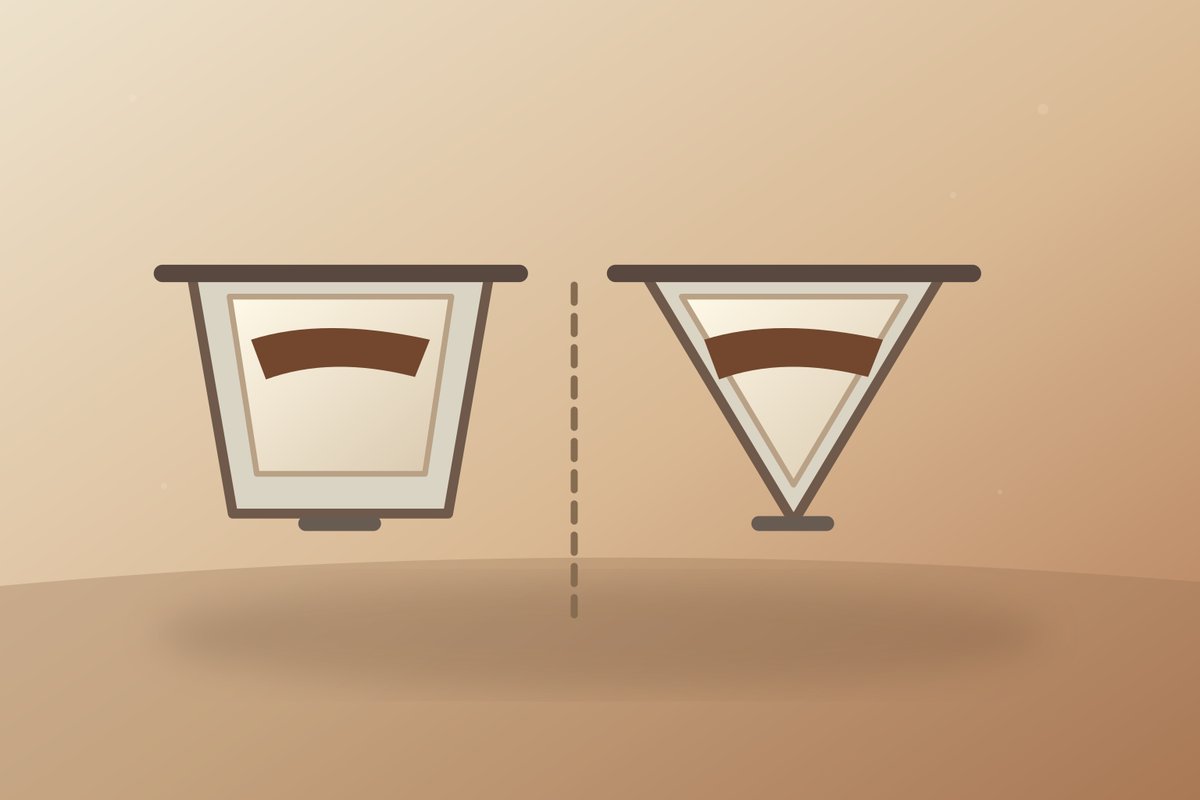
Use the filter shape your brewer or coffee maker was built for: flat-bottom filters in a flat-bottomed basket, cone filters in a cone. The shape is part of how the brewer works, so the wrong one folds, leaks, and lets water around the coffee. If you are choosing between brewers, the difference is real but modest. Cones often form a deeper bed and concentrate flow toward the tip; flat-bottom baskets spread the bed over a wider base. Actual drawdown and flavor also depend on the paper, holes, grind, dose, and pouring pattern, so neither shape is inherently faster or better.
Grind, ratio, and freshness all matter more than filter shape. But once those are right, shape is one of the things that decides whether a brewer suits you.
The filter shapes you will meet
| Shape | Looks like | Used in | Sizes |
|---|---|---|---|
| Basket | A fluted cupcake case, flat bottom | Most drip machines with a flat basket | 4-cup; 8–12 cup |
| Cone (wedge) | A V with a flat seam at the tip | Cone drip machines, Melitta-style drippers, the Clever | #1, #2, #4 |
| V60 cone | A true cone with a pointed tip | Hario V60 and similar cones | 01, 02, 03 |
| Wave | A flat-bottomed cup with 20 pleats | Kalita Wave and similar flat drippers | 155, 185 |
| Chemex | A thick folded circle or square | Chemex only | Sized to the Chemex |
Two of those are easy to confuse. Wedge cones, the #2 and #4 papers sold in supermarkets, have a flat seam at the bottom rather than a point, and fit wedge-shaped drippers and cone baskets. V60 papers are a steeper, true cone. They are not interchangeable, though in a pinch one can stand in for the other.
How the shape changes the brew
Water moves through coffee by the easiest route, and the filter shape decides what that route looks like.
| Cone | Flat bottom | |
|---|---|---|
| Coffee bed | Deep in the middle, thin at the edges | Shallow and even |
| Where water exits | Through one point at the tip | Across the whole flat base |
| Flow | Faster; your pour sets the pace | Slower and steadier |
| Sensitivity to pouring | High: a careless pour shows | Low: forgives an uneven pour |
| Where fines end up | Gathered at the tip | Spread across the base and holes |
| Tends to taste | Brighter, clearer | Rounder, sweeter, more even |
Cones concentrate the coffee into a deep bed, so water travels through a lot of coffee before it leaves. With a large single hole, like a V60, the water also drains as fast as you pour it, which is why cone pourover rewards a steady hand. It gives the brightest, most detailed cup when it is done well.
Flat bottoms spread the coffee into an even layer, so every part of the bed is about the same depth and water passes through it evenly. Most flat brewers also restrict the flow with small holes, so the brewer, not you, sets the pace. That makes them more consistent from cup to cup, which is why the Kalita Wave is the pourover this site recommends to people who want good coffee without a technique hobby.
The flat base does have one weakness: if the grind is too fine or you stir hard at the end, fine particles settle across it and slow the drain. Channeling, fines, and agitation explains why.
Does the shape change the taste?
Yes, but less than most people expect. Brew the same coffee at the same grind and ratio in a cone and a flat-bottom brewer, and the cone usually tastes a little brighter and lighter, the flat one a little sweeter and fuller. Most of that comes from the bed depth and flow speed above, which change the extraction slightly.
Research on drip machines from the UC Davis Coffee Center found that basket shape measurably changes extraction and flavour, even with everything else held the same. That is a good reason to use the filter your machine was designed for, and not a reason to buy a new machine: adjusting the grind changes the cup far more.
If you have both kinds of brewer, try the same coffee in each on the same day. You will find out quickly whether the difference matters to you.
Filter sizes
Cone filters are sized by number, and the number is about capacity, not shape.
| Size | Typical use |
|---|---|
| #1 | Single-cup drippers |
| #2 | Small drippers and small cone machines, about 2 to 6 cups; the small Clever |
| #4 | Full-size cone drip machines, about 8 to 12 cups; the large Clever |
| Basket, 4-cup | Small flat-bottomed drip machines |
| Basket, 8–12 cup | Standard flat-bottomed drip machines |
Specialty brewers use their own sizes: V60 01, 02, and 03; Kalita 155 and 185; and Chemex papers for each Chemex size. Buy the matching size. A filter that is too small collapses into the brewer, and one that is too big folds over and lets water run down the gap.
Swapping shapes in a pinch
| You have | Your brewer takes | Will it work? |
|---|---|---|
| Basket filter | Cone | Poorly. It folds into pleats that channel water. Fold it into a rough cone and brew as a one-off |
| Cone filter | Flat basket | No. The tip sits in the middle and the sides fall in. Grounds get past |
| #4 wedge cone | V60 | Yes, roughly. Fold the seams and press it in; expect a slower, less even drain |
| V60 cone | Wedge dripper | Yes, roughly; it sits loosely, so pour gently |
| Basket filter | Kalita Wave | As a stopgap, trimmed to fit; expect a faster, less even brew |
| Anything | Chemex | Only Chemex papers seal against its glass properly |
| Paper towel | Anything | Avoid: it tears and tastes of paper |
The rule of thumb: a filter that sits flat against the brewer’s walls, with no folds or gaps, works. One that folds over, collapses, or leaves a gap at the side lets water skip the coffee, which is a form of bypass, and the cup tastes thin.
Paper weight and colour
Thickness changes flow. Chemex papers are much thicker than the rest, which slows the brew and traps more oil and fine particles, giving the Chemex its exceptionally clean cup. Thin papers, like V60 papers, drain faster. Even papers of the same shape from different brands drain at different speeds, so if you switch brands and your brew time changes, adjust the grind.
White or brown. White filters are whitened, today usually with oxygen rather than chlorine, and taste the most neutral. Brown, unbleached filters are fine, but taste more of paper. Whichever you use, rinse the filter with hot water before adding coffee. It washes out the papery taste and warms the brewer.
Folding. Fold the crimped seams of a cone filter, along the bottom and up the side, before you open it. It then sits flat against the brewer instead of buckling.
Paper, metal, or cloth
Shape is one choice; material is another.
- Paper traps most oils and fine particles: the cleanest, brightest cup.
- Metal mesh lets oils and some fines through: more body, a little sediment. Metal filters are reusable and come in both cone and basket shapes.
- Cloth sits between the two: clean but with more body than paper. It needs rinsing and careful drying so it does not go sour.
Paper also holds back cafestol, a compound in coffee oil that raises cholesterol, which matters if you drink several cups a day. Filtered vs unfiltered coffee covers the health side, and the drip guide has more on choosing.
Which should you choose?
| If you are… | Choose |
|---|---|
| Buying filters for a drip machine | Whatever shape the basket is. Check the manual for the size |
| Choosing a pourover for a reliable daily cup | Flat bottom: a Kalita Wave |
| Choosing a pourover for the brightest cup, and enjoy technique | Cone: a V60 |
| Brewing for several people by hand | A Chemex |
| Wanting the easiest possible clean cup | A Clever Dripper, with cheap #4 cone filters |
| Buying a drip machine | Either shape. Pick on temperature and brew time; see the drip guide |
Compare filters without confusing shape and paper
To test the effect of basket geometry, keep the same coffee, dose, water, temperature and target beverage weight. Match grind as a starting point, then record total drawdown and taste. Different papers and outlet designs may change resistance more than the shape alone. If you switch filters, adjust one variable at a time using the grind guide; do not attribute every taste change to the cone or flat base.
Fix the filter
| What you notice | Likely cause | First change |
|---|---|---|
| Filter collapses or folds over | Wrong size or shape, or seams not folded | Use the matching size; fold the seams first |
| Grounds in the cup | Filter folded over, or the wrong shape | Use the shape the brewer takes |
| Basket overflows | Too fine a grind, or too much coffee for the basket | Grind coarser, or brew a smaller batch |
| Brew drains very slowly | Fines on a flat base, or a thick paper | Grind a step coarser; do not stir at the end |
| Thin, watery cup | Water running down gaps beside the paper | Make sure the filter sits flat against the walls |
| Papery taste | Unrinsed filter, especially brown | Rinse the filter with hot water first |
| Brew time changed with new filters | A different paper | Adjust the grind for the new filters |
If the filter is right and the cup still is not, the problem is elsewhere in the recipe. Fix sour, bitter, or weak coffee starts from what you taste.