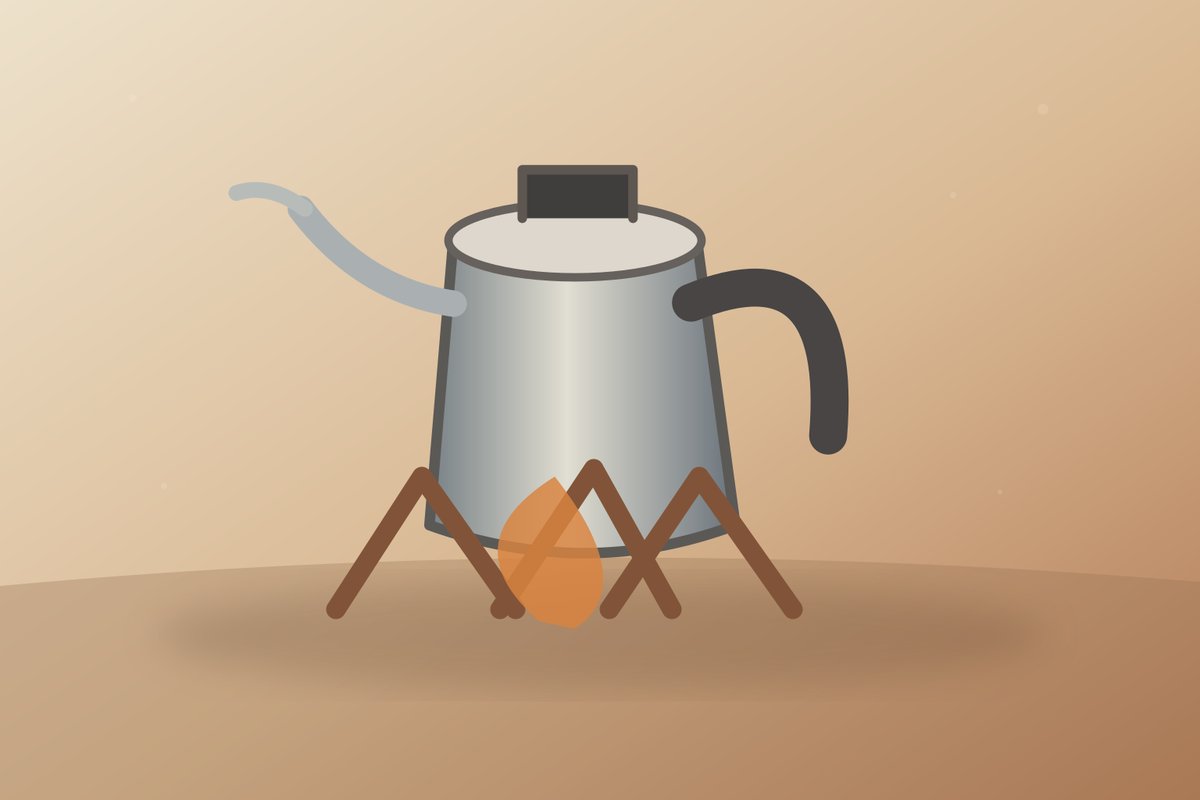
To make cowboy coffee, bring water to a boil, take the pot off the heat, stir in coarse ground coffee, and let it steep for four minutes. Then let the grounds settle for a minute and pour slowly; a small splash of cold water is optional, not a guaranteed way to sink all fines. Use about 22g of coffee, roughly 4½ level tablespoons, for every 12-ounce camp mug. The coffee never goes back on the flame.
Cowboy coffee is the simplest brewer there is: a pot, some water, and some coffee. It has a reputation for being bitter and full of grit, and most of that comes from one habit, boiling the grounds. Steep them like a French press instead and the pot makes a clean, full-bodied cup with nothing to pack but what you already cook with.
Start with this recipe
For one 12-ounce mug. Multiply everything for more people; the table below does the maths.
- Bring 350g (about 1½ cups) of water to a boil in a pot or kettle.
- Take it off the heat and wait about 30 seconds, until it stops bubbling.
- Stir in 22g of coarse ground coffee. Push any dry clumps under so every bit is wet.
- Cover and wait 4 minutes. A lid, a plate, or a bit of foil keeps the heat in.
- Settle the grounds. Stir once, then pour a small splash of cold water, a tablespoon or two, over the surface. Wait another minute.
- Pour slowly into the mug, tilting the pot gently and stopping when you see grounds at the lip. Leave the last half inch behind.
You will get a little less coffee than the water you started with, about 300g in the mug, because the grounds soak some of it up and the last of the pot stays with the sludge.
Why you should not boil it
The traditional method puts the coffee in cold water and boils the lot, sometimes for minutes. That is the version people remember as harsh.
Coffee tastes best when the water extracts the sweet, pleasant flavours and stops before the bitter, woody ones. Boiling water keeps pulling long after that point, and the rolling boil churns the grounds, breaking them into finer pieces that extract even faster and will not settle. You end up with coffee that is both bitter and gritty.
Taking the pot off the heat first fixes both. Water just off the boil is in the right range for brewing, and still water lets the grounds sink. That is the whole trick: cowboy coffee is French press coffee without the plunger.
How much coffee and water
The ratio is the site’s usual 1:16, the same as the French press and coffee without a coffee maker. Camp mugs tend to be bigger than kitchen ones, so the table is in 12-ounce mugs.
| Mugs (12 oz) | Coffee | Level tbsp | Water |
|---|---|---|---|
| 1 | 22g | 4½ | 350g (1½ cups) |
| 2 | 44g | 9 | 700g (3 cups) |
| 4 | 88g | 18 (just over 1 cup) | 1,400g (6 cups) |
| 6 | 132g | 26 (about 1⅔ cups) | 2,100g (9 cups) |
Spoon measures are approximate, so if you have a pocket scale, weigh the coffee at home instead. How much coffee per cup explains why a spoonful of one coffee can weigh noticeably more than a spoonful of another.
Leave room in the pot. Coffee grounds and the stirring need space, so fill it no more than about three quarters full. For a big group, two pots brewed one after the other beat one pot filled to the brim.
Getting the grounds to sink
Fresh coffee floats. The grounds hold gas from roasting, and they sit in a crust on top until they have soaked through. Three things get them to the bottom:
- Stir once at the end of the steep. It breaks the crust and lets water into the grounds that were floating dry.
- Splash in cold water. A tablespoon or two poured over the surface sinks through the hotter coffee and takes floating grounds down with it. It works; it just is not magic, so give it the full minute.
- Tap the side of the pot a few times with a spoon. It knocks loose the grounds stuck to the surface.
Some campers swear by a crushed eggshell in the pot. You do not need one. The settling is done by the stir, the cold splash, and the wait, and they cost nothing.
Then pour like you mean it: slowly, in one steady tilt, without setting the pot down and picking it up again. Every time the pot rocks, the grounds on the bottom lift back up.
Grind and coffee to bring
Grind coarse, like rough sand or sea salt: your French press setting, or a step coarser. Coarse grounds are heavier, so they sink faster, and they are easy to pour away from. Fine coffee turns the bottom of the pot into mud and ends up in your teeth.
If you are buying pre-ground coffee for a trip, choose the coarsest grind you can find, labelled for French press or percolator. Drip grind works, but it brews faster and settles slower, so steep it for 3 minutes rather than 4 and give it an extra minute to settle.
Ground coffee goes stale within days, so if you have a hand grinder, take it and grind at camp. If not, grind at home as close to the trip as you can and pack the coffee in an airtight bag with the air pressed out. How long coffee stays fresh has the details.
A dark or medium roast is the forgiving choice here. It tastes good even when the brew is a little off, and its chocolatey flavours hold up to the heavier body of unfiltered coffee.
On a campfire or a camp stove
On a camp stove, follow the recipe as written. Camp stoves are fast, so do not walk away while the water heats. Turn the burner off, rather than down, before the coffee goes in.
On a fire, heat the water over coals rather than leaping flames, and then lift the pot right away from the fire to steep. A pot left near the heat keeps the coffee too hot, and a pot left on the grate will boil it. Use a glove or a pot grip; the handle will be hot.
At altitude, water boils at a lower temperature, roughly 1°C less for every 300 metres. Skip the 30-second wait and add the coffee as soon as the boil stops. If it still tastes sour and thin, steep a minute longer. Water temperature for coffee explains why.
Whatever you heat it on, the pot itself should be metal: steel, aluminium, or enamel. Most cooking pots are fine. A narrow spout or a kettle-style pour helps you pour slowly and leave the grounds behind.
Getting rid of the grounds
Pack used grounds out with your rubbish. Do not tip them into a stream or lake, and do not bury them; they break down slowly and attract animals. A sealable bag kept for the purpose is the easiest way. Rinse the pot well away from any water source, and scatter the rinse water.
Cowboy coffee or another camp brewer?
Cowboy coffee is the one to choose when the goal is to carry nothing extra. If you have a little space to spare, a dedicated brewer will make a cleaner cup.
| Brewer | What it adds | Tradeoff | Best for |
|---|---|---|---|
| Cowboy coffee | Nothing; uses your cooking pot | Some sediment; takes a steady pour | Ultralight trips, or a forgotten brewer |
| Percolator | One pot that brews and pours with no grounds | Easy to over-brew; heavy | Car camping and groups |
| French press | A plunger, so no settling or careful pouring | Bulky; glass ones break | Car camping |
| AeroPress | A clean, grit-free cup; light and unbreakable | One or two cups at a time | Backpacking with good coffee |
| A pourover cone | Paper-filtered, very clean cup | Needs filters and a steady pour | Light-roast fans |
For backpacking, the AeroPress is the best cup per gram you carry. For a car-camping crowd, a percolator or two pots of cowboy coffee will serve everyone faster than any single-cup brewer.
Make a camp batch safely
Keep the pot stable and use a heatproof grip; never seal a vessel while heating it. At altitude, water boils at a lower temperature, so use water straight off the boil and adjust steep time by taste instead of assuming a fixed temperature. Strain through a clean filter if you want fewer grounds: settling alone cannot eliminate fines. Pack used grounds out where local land-use rules require it. For filter-free alternatives, compare French press and percolator.
Fix the cup
| What you notice | Likely cause | First change |
|---|---|---|
| Bitter, harsh | Coffee was boiled, or steeped near the heat | Take the pot off the heat before adding coffee, and keep it off |
| Gritty | Grind too fine, or poured too fast | Grind coarser, settle a minute longer, and pour in one steady tilt |
| Sour, thin | Water too cool, often at altitude or in the cold | Add the coffee straight off the boil, and steep a minute longer |
| Weak but pleasant | Too little coffee | Add another 3 to 5g per mug next time |
| Flat, papery | Stale pre-ground coffee | Grind closer to the trip, and pack it airtight |
| Still brewing, getting stronger | Grounds left sitting in the coffee | Pour it all off the grounds into mugs or a flask |
That last one catches people out. Cowboy coffee keeps steeping as long as it sits on the grounds, so the second cup from the pot is always stronger and more bitter than the first. If not everyone is ready, pour the rest into a vacuum flask.
For anything else, fix sour, bitter, or weak coffee goes through each taste in more detail.