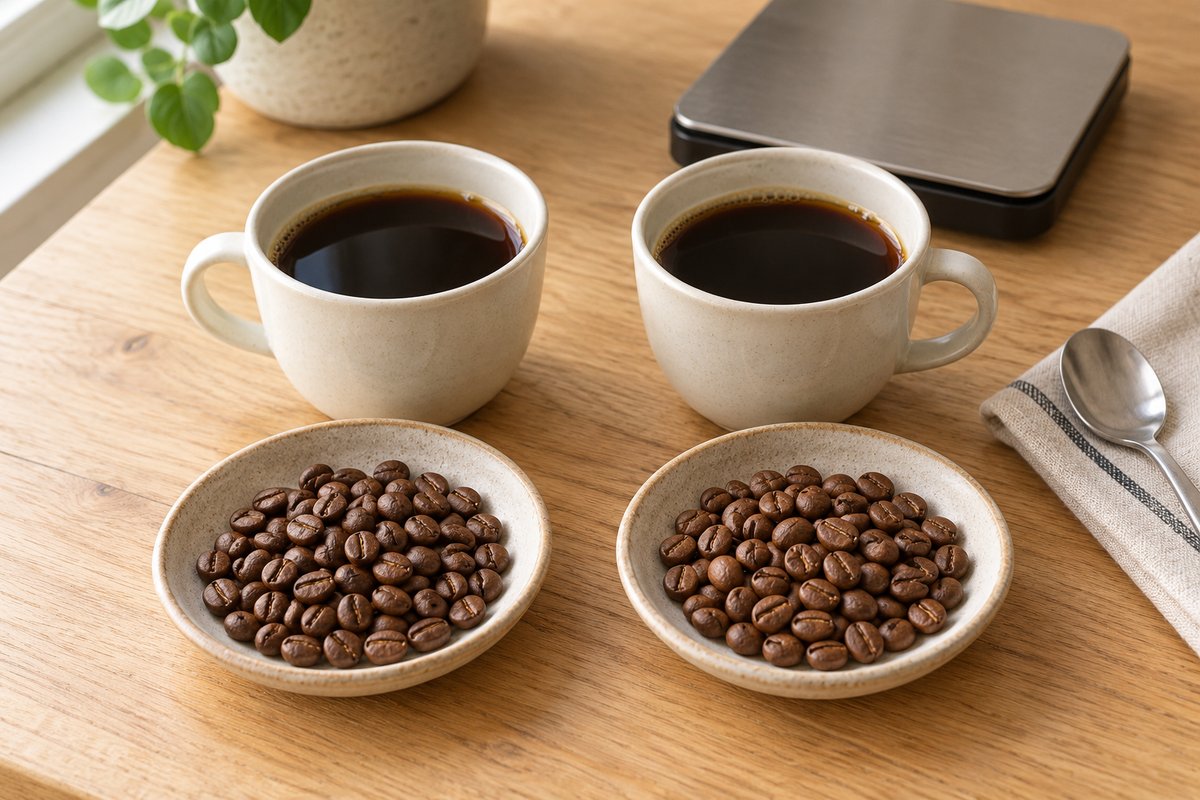
Arabica usually tastes sweeter and brighter. Robusta usually tastes heavier and more bitter, with about 1.5 to 2 times the caffeine per gram of beans. For most home brewing, start with arabica. Try a robusta blend for espresso with milk, or a robusta-heavy dark roast for Vietnamese coffee.
These are two different species of coffee plant: Coffea arabica and Coffea canephora, commonly sold as robusta. World Coffee Research’s varieties catalog covers both. The name tells you the species, not the roast level, freshness, or quality of the bag.
Arabica and robusta side by side
These are common tendencies, not promises about every coffee.
| What changes | Arabica | Robusta |
|---|---|---|
| Taste | Often sweet, fruity, floral, nutty, or chocolatey | Often earthy, nutty, cocoa-like, and more bitter |
| Brightness | Usually more noticeable fruity acidity | Usually less fruity acidity |
| Body | Often lighter and clearer | Often heavier |
| Caffeine, at the same bean weight | Lower | Typically about 1.5 to 2 times as much |
| Crema in espresso | Can produce plenty; freshness and brewing matter | Usually produces more foam; more crema does not mean better flavor |
| Growing conditions | Generally suited to cooler conditions, often at higher elevations | Generally suited to warmer conditions, often at lower elevations |
| Disease resistance | Varies by variety; some are bred to resist leaf rust | Often more resistant to some diseases, but still vulnerable to pests and disease |
| Price | Often higher for comparable commercial grades | Often lower for comparable commercial grades; carefully produced lots can cost more |
| Typical uses | Single-origin and specialty coffee, filter coffee, espresso | Instant coffee, espresso blends, Vietnamese coffee, and some single-origin bags |
Roast can change the comparison more than you expect. A dark arabica can taste more bitter than a medium-roast robusta. If you want chocolate and nuts rather than fruit, try a medium-roast arabica before deciding you need robusta.
Which beans should you buy?
| The cup you want | Start with |
|---|---|
| Sweet or fruity pourover or drip coffee | A fresh arabica with a light or medium roast |
| A clear espresso to drink straight | A medium-roast arabica |
| A heavier espresso for milk drinks | A medium or dark espresso blend with some robusta |
| Traditional Vietnamese coffee | A dark-roast robusta or robusta-heavy blend |
| More caffeine at the same dose | A blend that states its robusta percentage |
| Less caffeine | Decaf; arabica still contains caffeine |
| Good coffee on a budget | A small, fresh bag at a roast level you enjoy, whichever species it contains |
If you are unsure, buy a small bag of medium-roast arabica. It is an easy starting point across the recipes on this site. An espresso blend with around 10–20% robusta is a reasonable first comparison if you want more body in milk; that is a tasting suggestion, not a quality threshold.
For less caffeine, changing species is a smaller step than switching to decaf coffee. For less fruity sharpness, choose by roast and flavor notes as well as species. Taste acidity is not a measure of how coffee will sit in your stomach; low-acid coffee explains that distinction.
Why do they taste different?
The beans start with different balances of sugars, oils, caffeine, and acids. Arabica generally contains more sugar and oil; robusta generally contains more caffeine and chlorogenic acids. Roasting transforms those ingredients into the aromas and flavors you taste, so sweetness is not simply unroasted sugar surviving in your cup.
Chlorogenic acids are naturally occurring compounds in coffee. Some of their roasting breakdown products contribute bitterness, as Thomas Hofmann’s group reported in research presented at the American Chemical Society in 2007. Caffeine tastes bitter too, but it does not account for all of coffee’s bitterness.
None of this makes species a complete flavor forecast. Picking ripe cherries, processing them carefully, and roasting well all matter. Coffee flavor profiles shows how to read those other clues on a bag.
Why is robusta used in espresso blends?
Robusta can add body, a more forceful flavor, extra caffeine, and more crema, the foam on top of an espresso. It can also lower the cost of a commercial blend. A smaller share is a way to add those qualities while keeping much of arabica’s character.
Thicker crema is not a taste test. Wang and colleagues’ 2019 study found more crema from robusta, but more stable crema from arabica under its test conditions. Coffee freshness also affected the amount of foam. A thin layer does not prove a shot is bad, and a thick layer does not prove it is sweet or well extracted.
If you drink espresso with milk, a robusta blend is worth comparing with your usual bag. If you drink it straight, start with arabica unless you already enjoy a heavier, more bitter style. Both can make good espresso; espresso ratios explains how the amount you pull changes the result.
A high robusta percentage does not automatically make a blend harsh. Poor-quality beans, a roast you dislike, or an unsuitable recipe can do that with either species.
Is robusta lower-quality coffee?
Not automatically. Much of it is sold for inexpensive blends and instant coffee, but carefully produced robusta can have cocoa, nutty, and other distinct flavors. The Coffee Quality Institute developed separate Fine Robusta standards and tasting protocols to assess it on its own terms.
Look for a roaster that gives you an origin, processing details, roast date, and useful tasting notes. A “fine robusta” label is a clue to investigate, not a guarantee that you will enjoy the cup.
The same caution applies to “100% arabica.” It tells you the species, not that the coffee was picked, stored, or roasted well. Keep freshness in the decision: how to store coffee beans covers roast dates and keeping a bag tasting lively.
How much more caffeine does robusta have?
A useful rule of thumb is about 1.5 to 2 times as much caffeine per gram of beans. Compare equal coffee doses before applying it to a cup. A small robusta drink can still contain less caffeine than a large arabica drink.
If robusta has 1.5–2 times the caffeine of the arabica it replaces, these are the expected changes for a blend mixed by bean weight:
| Robusta share | Extra caffeine |
|---|---|
| 10% | About 5–10% more |
| 20% | About 10–20% more |
| 30% | About 15–30% more |
| 50% | About 25–50% more |
| 100% | About 50–100% more |
For example, 20g of an 80/20 blend contains 16g arabica and 4g robusta. Under that assumption, its bean caffeine is roughly equivalent to 22–24g of the arabica alone. That is a comparison, not a measurement of milligrams in the finished drink. Variety, roast, and brewing change the result.
Do not infer caffeine from bitterness, crema, or a “strong” label. The caffeine guide compares serving sizes, doses, and brewing methods.
How can you tell what is in the bag?
Read the label or ask the roaster. Bean shape is not reliable identification.
- “100% arabica” declares that the coffee is all arabica. Still check the roast date and flavor notes.
- “Robusta,” “canephora,” or “conilon” indicates Coffea canephora. World Coffee Research describes conilon as one of the regional names used for these coffees.
- “Blend,” “espresso blend,” or “Italian style” does not tell you the species or percentage. A blend may be all arabica, or may include robusta.
- “Single-origin” describes where the coffee comes from, not which species it is.
- A missing species label proves nothing. Ask if the answer matters to you, especially if you are choosing for caffeine.
Arabica beans often look more oval and robusta beans more rounded, but size, variety, processing, and roasting overlap. A curved or straight center crease cannot verify a bag’s contents, and neither can the color of the roasted beans.
Do you need a different recipe for robusta?
Start with the recipe for your brewer. Choose the grind and temperature by the roast and the taste of the cup, rather than by species alone. A medium-roast robusta does not automatically need the treatment of a very dark espresso blend.
For a dark blend that tastes harsh, change one thing at a time:
- Filter coffee: try a slightly coarser grind first. If the cup still tastes harsh, try slightly cooler water; water temperature for coffee gives the ranges by roast.
- Espresso: keep the dose steady and use the Espresso Compass to choose a change from the shot’s taste and flow.
- A concentrated milk drink: use a recipe built for concentration, such as a moka pot, rather than adding an arbitrary amount of coffee to a filter recipe.
If the cup tastes pleasantly balanced but too strong, dilute it with a little water. If it tastes bitter or drying, fix that taste problem before assuming the species is the cause.
Compare two bags without changing everything
Buy small bags at similar roast levels. Keep the brewer, water, coffee dose, and water weight the same for the first comparison. For example, the site’s French press recipe uses 20g coffee and 320g water for one mug.
Taste both black once they have cooled enough to sip comfortably. Compare sweetness, fruity sharpness, bitterness, and how heavy each feels. Then add the same amount of milk if that is how you normally drink coffee.
Adjust the grind for each bag on later brews if needed. Two bags cannot isolate species perfectly because origin and processing differ too, but they can tell you which one you would rather drink every morning.